

Introduction
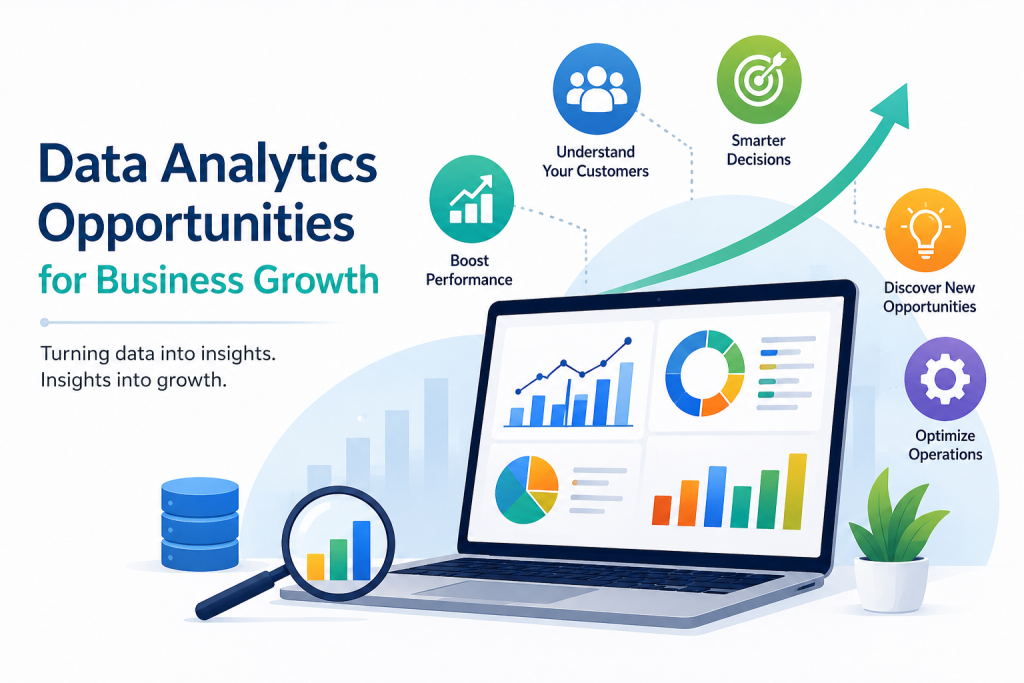
In today’s rapidly evolving business environment, Data Analytics Opportunities for Business Growth are becoming essential for organizations looking to improve decision-making, enhance customer experiences, and discover new revenue possibilities. Businesses across industries are generating massive amounts of data from digital platforms, customer interactions, operations, and connected systems. When properly analyzed, this information can help companies identify patterns, optimize resources, and create strategies that support long-term growth.
Data analytics is no longer limited to large enterprises with advanced technology teams. Small and medium-sized businesses are also adopting analytics-driven approaches to understand market changes, improve efficiency, and compete in increasingly digital markets. The ability to convert raw information into meaningful insights is creating new opportunities for innovation and business expansion.
Improving Decision-Making Through Real-Time Insights
One of the biggest opportunities created by data analytics is the ability to make faster and more informed decisions. Traditional business decisions often depended on historical reports and assumptions, but analytics allows companies to use current information to respond quickly to changing conditions.
Real-time analytics helps businesses monitor sales performance, customer behavior, supply chain activities, and operational challenges. For example, companies can identify which products are performing well, understand customer preferences, and adjust strategies based on actual data rather than guesswork.
Organizations using analytics platforms can also identify risks earlier. By analyzing patterns and trends, businesses can improve planning, reduce uncertainty, and develop more flexible strategies.
Enhancing Customer Experience and Personalization
Customer expectations are changing rapidly, and businesses need deeper insights to provide personalized experiences. Data analytics enables companies to understand customer journeys, purchasing habits, preferences, and engagement patterns.
Through customer data analysis, businesses can create targeted marketing campaigns, recommend relevant products, and improve communication strategies. Personalized experiences can increase customer satisfaction and encourage stronger brand relationships.
For industries such as retail, banking, healthcare, and entertainment, analytics provides opportunities to deliver services that are more aligned with individual customer needs. Businesses that understand their customers better can create stronger competitive advantages.
Optimizing Business Operations
Operational efficiency is a major area where data analytics creates growth opportunities. Companies can analyze internal processes to identify inefficiencies, reduce unnecessary costs, and improve productivity.
For example, analytics can help businesses optimize inventory management by predicting demand and preventing overstocking or shortages. Manufacturing companies can use data insights to improve production planning and reduce equipment downtime through predictive maintenance.
Supply chain analytics also allows organizations to track performance, improve logistics planning, and create more reliable delivery systems. These improvements help businesses operate more efficiently while maintaining quality and customer satisfaction.
Creating New Revenue Opportunities
Data analytics is opening new opportunities for businesses to develop innovative revenue streams. By studying customer behavior and market patterns, organizations can discover new product ideas, service improvements, and business models.
Companies can use analytics to identify emerging customer needs and develop solutions before competitors. Data-driven insights can also support pricing strategies by helping businesses understand demand patterns and customer willingness to pay.
In digital industries, companies are increasingly using data as a valuable business asset. Analytics can transform information into actionable strategies that support expansion and profitability.
Supporting Artificial Intelligence and Automation
The growth of artificial intelligence and automation is increasing the importance of data analytics. AI systems depend on accurate and organized data to deliver valuable results. Businesses that build strong analytics capabilities can take advantage of automation tools for better efficiency.
Analytics combined with AI can support areas such as customer service automation, fraud detection, demand forecasting, and workflow optimization. These technologies help companies reduce manual tasks and focus on strategic activities.
As businesses continue adopting intelligent solutions, data analytics will play a central role in enabling smarter operations and improving competitiveness.
Strengthening Marketing Strategies
Modern marketing requires a deeper understanding of customer behavior, and analytics provides valuable insights for campaign optimization. Businesses can analyze customer engagement, website activity, social media interactions, and purchasing trends to improve marketing performance.
Data-driven marketing allows organizations to identify the most effective channels, create relevant content, and allocate resources more efficiently. Instead of using broad approaches, businesses can focus on strategies that connect better with specific audiences.
Analytics also supports continuous improvement by helping marketers measure results and adjust campaigns based on performance insights.
Expanding Opportunities Across Industries
Data analytics opportunities are expanding across various sectors. In healthcare, analytics can support improved patient services and operational planning. In finance, businesses can use analytics for risk management and customer solutions. In transportation, data insights can improve routing, efficiency, and service quality.
The adoption of connected devices, digital platforms, and cloud technologies is creating even more opportunities for businesses to collect and analyze information. As industries become more data-driven, companies with strong analytics capabilities will be better positioned to identify growth opportunities.
Overcoming Challenges in Data Analytics Adoption
Although data analytics provides significant opportunities, businesses must address challenges such as data quality, security, and skilled workforce requirements. Poor-quality data can lead to inaccurate insights, while weak security practices can create privacy concerns.
Organizations need effective data management strategies, strong cybersecurity practices, and employees with analytical skills to maximize the value of their data. Investing in the right technology and building a data-focused culture can help businesses achieve better outcomes.
Future Outlook
The future of business growth will increasingly depend on the ability to understand and use data effectively. As digital transformation continues, analytics will become a core business capability rather than an optional tool.
Businesses that successfully integrate analytics into their strategies can improve efficiency, create better customer experiences, and discover new opportunities for innovation. From smarter decision-making to personalized services and automated operations, data analytics is becoming a powerful driver of sustainable growth.
Conclusion
Data analytics offers businesses a wide range of opportunities to improve performance, identify new possibilities, and build stronger strategies. By transforming information into actionable insights, companies can respond faster to challenges and create more value for customers.
As competition increases across industries, organizations that embrace analytics-driven approaches will have greater opportunities to innovate, adapt, and achieve long-term business growth.