
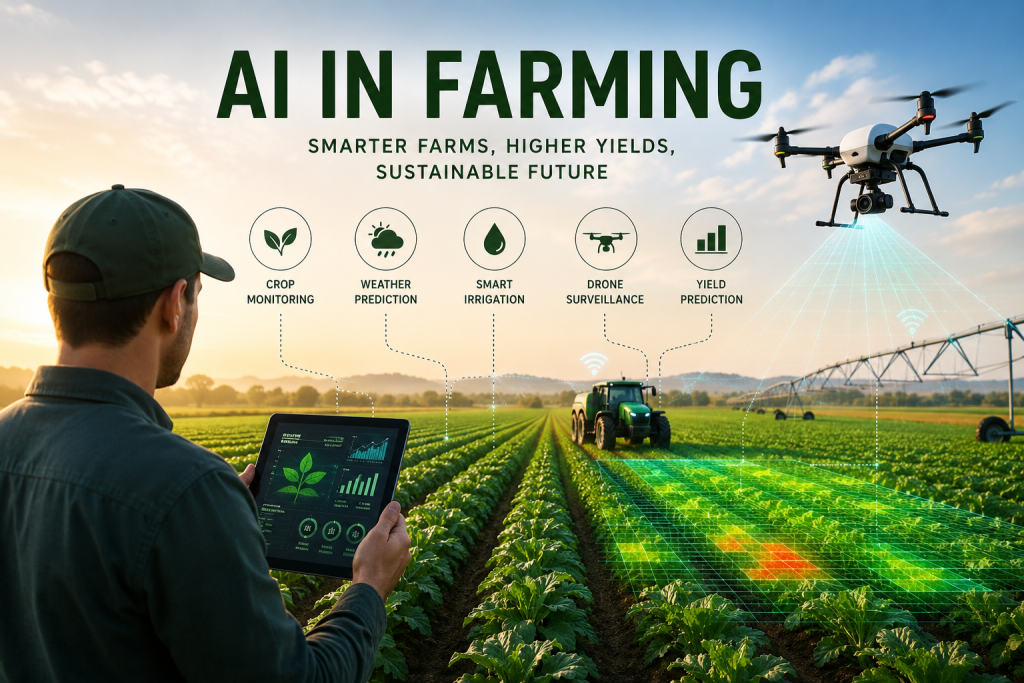

Artificial Intelligence (AI) is rapidly becoming one of the most exciting opportunities in modern agriculture. As the world faces growing food demand, unpredictable weather patterns, labor shortages, and the need for sustainable farming, AI is helping farmers make smarter, faster, and more informed decisions.
Unlike traditional farming methods that rely heavily on experience and manual observation, AI-powered farming combines data, machine learning, computer vision, drones, sensors, and automation to improve productivity while reducing costs and environmental impact. From monitoring crop health to predicting harvest yields, AI is changing the future of agriculture.
Why AI in Farming Matters
Agriculture is one of the world’s oldest industries, but it is now embracing one of the newest technologies. Farmers generate enormous amounts of data every day—from soil conditions and weather forecasts to crop health and equipment performance. AI can process this information in real time, providing recommendations that help farmers optimize every stage of crop production.
With global food demand expected to continue rising over the coming decades, improving agricultural efficiency has become more important than ever. AI provides an opportunity to produce more food using fewer resources while supporting sustainable farming practices.
How AI is used in Modern Farming
AI is transforming nearly every aspect of agriculture. Some of its most important applications include:
Precision Agriculture
Precision farming uses AI to analyze satellite imagery, drones, GPS systems, and field sensors. Instead of treating an entire field the same way, AI identifies specific areas that require attention.
This enables farmers to:
- Apply fertilizers only where needed
- Reduce pesticide usage
- Optimize irrigation
- Improve crop health
- Lower production costs
Smart Crop Monitoring
AI-powered cameras and drones continuously monitor crops throughout the growing season. Computer vision algorithms can detect:
- Early signs of disease
- Pest infestations
- Nutrient deficiencies
- Water stress
- Plant growth abnormalities
Early detection allows farmers to solve problems before they spread across entire fields.
Weather-Based Decision Making
Weather plays a major role in farming success. AI combines historical weather data with real-time forecasts to help farmers determine the best time to:
- Plant crops
- Irrigate fields
- Apply fertilizers
- Spray pesticides
- Harvest produce
Better timing often leads to higher yields and reduced losses.
Automated Farm Equipment
Modern tractors, harvesters, and agricultural machinery increasingly use AI to automate field operations.
Autonomous equipment can:
- Follow precise GPS routes
- Reduce fuel consumption
- Improve planting accuracy
- Harvest crops efficiently
- Operate with minimal human supervision
Automation also helps address labor shortages affecting many agricultural regions.
Yield Prediction
AI analyzes years of farming data along with weather conditions, soil quality, and crop performance to estimate harvest yields.
Accurate yield forecasting helps farmers:
- Plan storage capacity
- Manage supply chains
- Negotiate better prices
- Reduce food waste
- Improve financial planning
Benefits of AI in Farming
The adoption of AI offers significant advantages for both farmers and consumers.
Higher Productivity
AI helps maximize crop output by identifying the best farming practices based on real-time field conditions.
Lower Operating Costs
Targeted use of fertilizers, pesticides, and water reduces unnecessary spending while improving efficiency.
Sustainable Agriculture
AI encourages responsible resource management by minimizing waste and reducing environmental impact.
Improved Food Quality
Continuous monitoring helps produce healthier crops with fewer diseases and better overall quality.
Better Risk Management
AI allows farmers to anticipate weather events, pest outbreaks, and crop diseases before they become major problems.
Real-World Examples
Around the world, AI is already supporting modern agriculture.
Farmers use drones equipped with AI to inspect thousands of acres in a fraction of the time required for manual inspections. Smart irrigation systems automatically adjust water usage based on soil moisture levels. AI-powered robots identify weeds individually, allowing herbicides to be applied only where necessary instead of across entire fields.
Livestock farming is also benefiting from AI. Wearable sensors monitor animal health, feeding behavior, and movement patterns, helping farmers detect illnesses earlier and improve animal welfare.
Challenges to Overcome
Although AI offers enormous potential, several challenges remain.
High Initial Investment
Advanced AI equipment, drones, and smart sensors require significant upfront investment, which may be difficult for small farms.
Digital Infrastructure
Reliable internet connectivity and digital infrastructure are still limited in many rural areas.
Data Privacy
Farmers generate valuable agricultural data, raising important questions about ownership, privacy, and security.
Technical Skills
Successful AI adoption requires training and digital literacy to help farmers use new technologies effectively.
The Future of AI in Agriculture
The future of farming is becoming increasingly data-driven.
Emerging technologies will combine AI with robotics, Internet of Things (IoT) devices, satellite imagery, autonomous vehicles, and advanced weather forecasting systems. Farms may eventually operate with highly connected ecosystems where every machine, sensor, and crop continuously shares information.
Generative AI assistants are also beginning to help farmers interpret complex agricultural data, answer farming questions, generate reports, and recommend best practices using natural language.
As technology becomes more affordable and accessible, AI is expected to play a critical role in improving global food security while promoting sustainable agriculture.
Final Thoughts
AI in farming represents one of the biggest opportunities in agriculture today. By combining intelligent software with real-time field data, farmers can make better decisions, increase productivity, reduce costs, and use natural resources more responsibly.
While challenges such as infrastructure, affordability, and technical expertise still exist, continued innovation is making AI more practical for farms of all sizes. As agriculture continues its digital transformation, artificial intelligence will become an essential tool in building a more efficient, resilient, and sustainable global food system.