
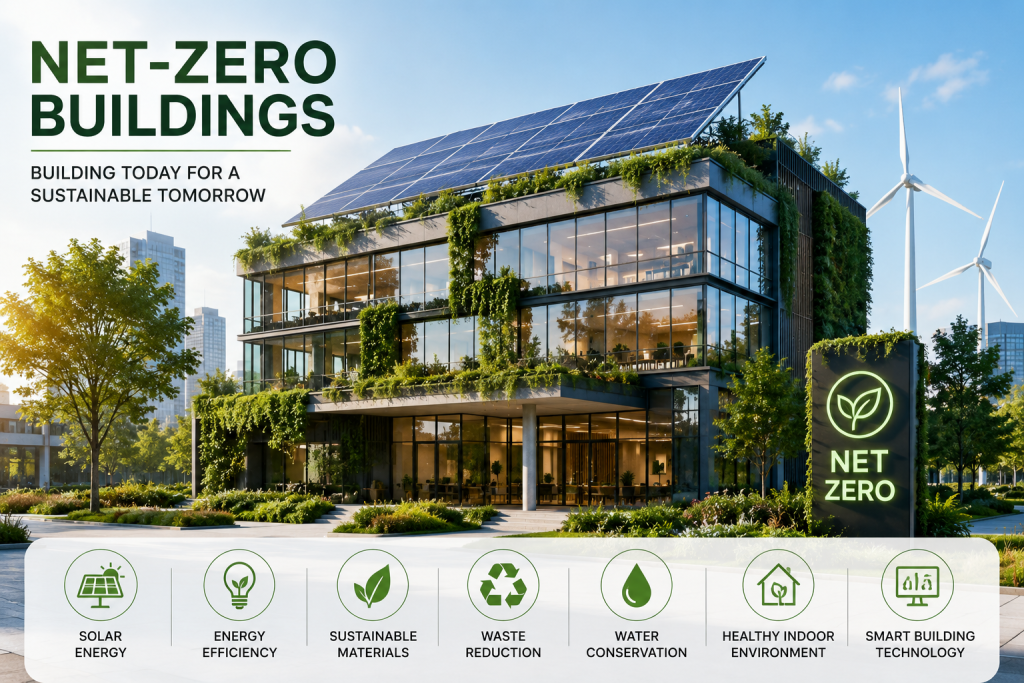

The buildings we live and work in account for a significant share of global energy consumption and carbon emissions. As governments, businesses, and homeowners strive to combat climate change, the construction industry is undergoing a remarkable transformation. At the heart of this shift is the concept of Net-Zero Buildings—structures designed to produce as much energy as they consume over the course of a year.
Once considered an ambitious vision, net-zero buildings are quickly becoming a practical reality. Advances in renewable energy, smart technologies, sustainable materials, and energy-efficient design are making it possible to create buildings that are environmentally responsible, economically viable, and comfortable for occupants.
What Is a Net-Zero Building?
A net-zero building is designed to minimize energy consumption through efficient construction practices while generating enough renewable energy to offset its annual energy use. The objective is simple: achieve a balance where the total energy consumed equals the total clean energy produced.
Unlike conventional buildings, which rely heavily on fossil fuel-based electricity, net-zero buildings incorporate advanced technologies that dramatically reduce energy demand before supplementing the remainder with renewable energy sources such as solar panels or wind energy.
This approach not only lowers utility costs but also significantly reduces greenhouse gas emissions.
The Core Principles Behind Net-Zero Design
Creating a net-zero building involves much more than installing rooftop solar panels. Success depends on integrating multiple energy-saving strategies from the earliest stages of design.
Some of the most important components include:
- High-performance insulation
- Energy-efficient windows and doors
- Smart HVAC systems
- LED lighting
- Solar photovoltaic systems
- Battery energy storage
- Smart building management systems
- Efficient water heating solutions
- Natural ventilation and daylight optimization
Together, these technologies work to reduce overall energy demand while maximizing renewable energy production.
Why Net-Zero Buildings Matter
The construction sector is responsible for a substantial portion of global carbon emissions. Improving building efficiency represents one of the most effective ways to reduce environmental impact while lowering long-term operational costs.
The benefits extend well beyond sustainability.
Lower Energy Bills
Because they consume significantly less energy, net-zero buildings can dramatically reduce monthly electricity expenses. Although construction costs may be higher initially, long-term savings often offset the additional investment.
Reduced Carbon Footprint
By relying on renewable energy and minimizing waste, net-zero buildings contribute directly to national and global climate goals.
Improved Indoor Comfort
Better insulation, efficient ventilation, and advanced climate control systems create healthier indoor environments with more consistent temperatures and improved air quality.
Higher Property Value
As buyers increasingly prioritize sustainability, energy-efficient buildings are becoming more attractive in both residential and commercial real estate markets.
Technology Is Making Net-Zero More Achievable
Rapid technological advancements are accelerating the adoption of net-zero construction across the world.
Artificial intelligence is helping optimize building energy usage in real time, while Internet of Things (IoT) sensors continuously monitor occupancy, lighting, heating, cooling, and electricity consumption.
Modern building management systems can automatically adjust operations based on weather conditions, occupancy patterns, and energy demand, reducing unnecessary consumption without sacrificing comfort.
Innovations in building materials are also making a significant impact. High-performance insulation, smart glass, reflective roofing systems, and low-carbon concrete improve energy efficiency while extending the lifespan of buildings.
Governments Are Driving the Transition
Many countries have introduced ambitious policies aimed at reducing emissions from buildings.
Building energy codes are becoming more stringent, encouraging developers to incorporate sustainable construction practices into new projects. Financial incentives, tax credits, and green financing programs are also helping offset the initial costs associated with energy-efficient construction.
Several cities have already established roadmaps requiring new public buildings—and in some cases all new developments—to meet net-zero or near net-zero energy standards over the coming decades.
These initiatives are accelerating innovation while encouraging collaboration between governments, architects, engineers, and technology providers.
Industries Embracing Net-Zero Construction
Net-zero principles are expanding far beyond residential housing.
Today, sustainable building practices are being adopted across:
- Commercial office buildings
- Educational institutions
- Healthcare facilities
- Hotels and resorts
- Retail centers
- Warehouses and logistics hubs
- Manufacturing facilities
- Government infrastructure
Large corporations are increasingly investing in net-zero campuses to reduce operating costs while demonstrating environmental leadership.
Challenges That Still Need to Be Addressed
Despite growing momentum, widespread adoption of net-zero buildings is not without obstacles.
Higher upfront construction costs remain a concern for some developers, although these costs continue to decline as technologies mature.
Retrofitting older buildings also presents technical and financial challenges, particularly in densely populated urban environments where structural modifications can be complex.
In addition, successful net-zero projects require collaboration across architects, engineers, contractors, and energy specialists from the earliest planning stages.
However, as innovation continues and economies of scale improve, these barriers are expected to diminish.
The Future of Net-Zero Buildings
Net-zero buildings are no longer a niche concept—they are rapidly becoming the benchmark for sustainable construction worldwide.
Over the next decade, advancements in artificial intelligence, digital twins, renewable energy integration, battery storage, smart materials, and modular construction are expected to make net-zero buildings more affordable and accessible than ever before.
The rise of electric vehicles may also reshape building design, with homes and commercial facilities increasingly integrating EV charging stations powered by onsite renewable energy.
As governments strengthen climate policies and businesses pursue ambitious sustainability goals, demand for net-zero construction is expected to accelerate across virtually every sector.