
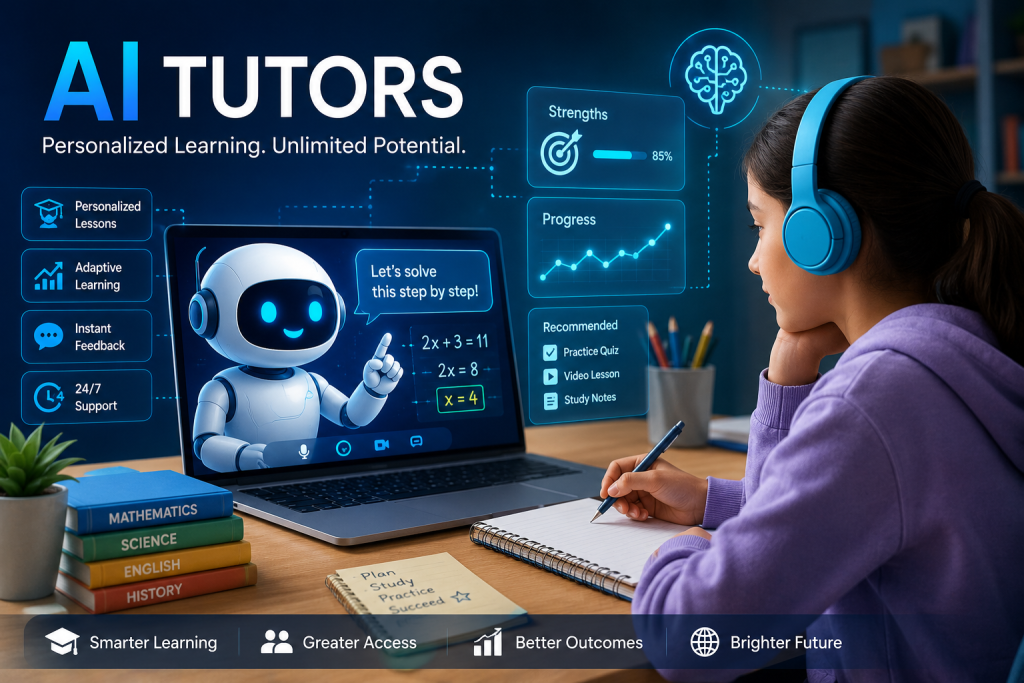

Artificial intelligence is reshaping industries worldwide, and education is emerging as one of its most promising frontiers. Among the most significant innovations is the rise of AI tutors—intelligent digital learning assistants capable of delivering personalized instruction, instant feedback, and adaptive learning experiences. As schools, universities, businesses, and independent learners increasingly embrace digital education, AI tutors are creating new opportunities for educators, technology providers, and investors alike.
Unlike traditional online learning platforms that simply deliver pre-recorded content, AI tutors interact with learners in real time. They identify strengths and weaknesses, adjust teaching methods based on individual progress, and provide explanations tailored to each student’s learning style. This shift is making quality education more accessible, scalable, and affordable across the globe.
What Are AI Tutors?
AI tutors are software applications powered by artificial intelligence technologies such as machine learning, natural language processing (NLP), and generative AI. They function as virtual teachers by helping learners understand concepts, answer questions, generate quizzes, provide practice exercises, and monitor academic performance.
Modern AI tutors can support numerous subjects, including:
- Mathematics
- Science
- Programming
- Languages
- Business studies
- Test preparation
- Professional certifications
Many platforms are available 24/7, allowing learners to receive assistance whenever they need it rather than waiting for scheduled tutoring sessions.
Why AI Tutors Represent a Major Market Opportunity
Growing Demand for Personalized Learning
Every learner progresses at a different pace. Traditional classrooms often struggle to provide individualized attention because one teacher must manage many students simultaneously.
AI tutors address this challenge by:
- Customizing lesson plans
- Adjusting question difficulty
- Repeating concepts when necessary
- Tracking learning patterns
- Providing individualized recommendations
This personalized experience significantly improves engagement and learning outcomes.
Expanding Access to Education
Millions of students worldwide lack access to qualified teachers due to geographic, financial, or institutional limitations.
AI tutors help bridge these gaps by offering:
- Affordable tutoring
- Multilingual support
- Remote accessibility
- Mobile-based learning
- Continuous availability
This democratization of education is opening entirely new markets, particularly in developing regions.
Key Industries Benefiting from AI Tutors
K-12 Education
Schools are integrating AI tutors to supplement classroom instruction through homework assistance, adaptive practice, and personalized revision.
Higher Education
Universities are using AI-powered learning assistants to help students understand complex subjects, prepare for exams, and receive instant academic support.
Corporate Learning
Organizations increasingly rely on AI tutors to train employees efficiently. Personalized training modules improve knowledge retention while reducing training costs.
Professional Certification
AI tutors assist candidates preparing for certification exams in fields such as:
- Information Technology
- Finance
- Healthcare
- Project Management
- Cybersecurity
Adaptive learning enables professionals to focus on areas requiring improvement.
Emerging Technologies Driving AI Tutors
Several technologies are accelerating AI tutor development:
- Large Language Models (LLMs)
- Natural Language Processing
- Speech Recognition
- Computer Vision
- Predictive Analytics
- Learning Analytics
- Cloud Computing
- Generative AI
Together, these technologies enable highly interactive, conversational, and context-aware learning experiences.
Business Opportunities for Companies
The rapid growth of AI tutoring creates opportunities across the education ecosystem.
EdTech Platforms
Education technology companies can develop subscription-based AI tutoring services for schools, universities, and individuals.
Educational Content Providers
Publishers can enhance textbooks with interactive AI companions that explain concepts and generate personalized exercises.
Schools and Universities
Educational institutions can reduce teacher workloads by automating repetitive tasks while allowing instructors to focus on mentoring and critical thinking.
AI Infrastructure Providers
Cloud providers, AI software developers, and analytics companies benefit from increasing demand for educational AI solutions.
Benefits for Students
AI tutors provide several advantages that traditional learning environments cannot always offer.
24/7 Learning Support
Students receive immediate assistance regardless of location or time.
Personalized Feedback
Instead of generic answers, AI tutors adapt explanations based on previous performance.
Self-Paced Learning
Learners can revisit topics as many times as needed without pressure.
Interactive Learning
Gamification, quizzes, simulations, and conversational learning improve engagement.
Progress Tracking
Detailed dashboards help students monitor improvement and identify weak areas.
Opportunities for Teachers
Contrary to fears that AI will replace educators, current evidence suggests AI tutors work best as teaching assistants rather than replacements.
Teachers benefit by:
- Automating grading
- Creating lesson materials
- Generating quizzes
- Identifying struggling students
- Saving administrative time
This enables educators to focus on mentorship, creativity, and classroom interaction.
Challenges That Must Be Addressed
Despite strong growth prospects, AI tutors face several challenges.
Data Privacy
Educational platforms collect sensitive student information, making strong cybersecurity and privacy protections essential.
Accuracy
Generative AI systems may occasionally provide incorrect or misleading information, requiring human oversight.
Digital Divide
Reliable internet access and digital devices remain unavailable in many regions, limiting adoption.
Human Interaction
Students still benefit from emotional support, motivation, and social interaction that human teachers uniquely provide.
Ethical AI
Developers must ensure fairness, transparency, and reduced bias in AI-generated educational content.
Future Trends
Several developments are expected to shape the next generation of AI tutors.
- Voice-based tutoring assistants
- AI-powered virtual classrooms
- AR and VR immersive learning
- Emotion-aware tutoring systems
- Multilingual conversational AI
- Career-focused personalized learning
- AI-assisted collaborative learning
- Lifelong learning companions
As AI becomes more sophisticated, tutoring systems will evolve beyond answering questions to coaching learners through critical thinking, creativity, and problem-solving.
Why Investors Are Paying Attention
Global investment in educational technology continues to grow as institutions modernize learning experiences. AI tutors align with several long-term trends:
- Digital transformation in education
- Increasing internet penetration
- Remote and hybrid learning
- Workforce reskilling
- Personalized education
- Lifelong learning
These drivers create sustained opportunities for startups, established technology companies, educational institutions, and enterprise software providers.
Conclusion
AI tutors represent one of the most promising opportunities in the future of education. By combining artificial intelligence with personalized learning, they make quality education more accessible, efficient, and scalable than ever before. While challenges related to privacy, ethics, and human interaction remain, AI tutors are increasingly viewed as tools that complement—not replace—teachers.
As educational institutions, businesses, and learners continue embracing digital transformation, AI tutors are poised to become an essential component of modern learning ecosystems. Organizations that invest early in intelligent tutoring technologies will be well-positioned to benefit from the rapidly evolving education landscape.