
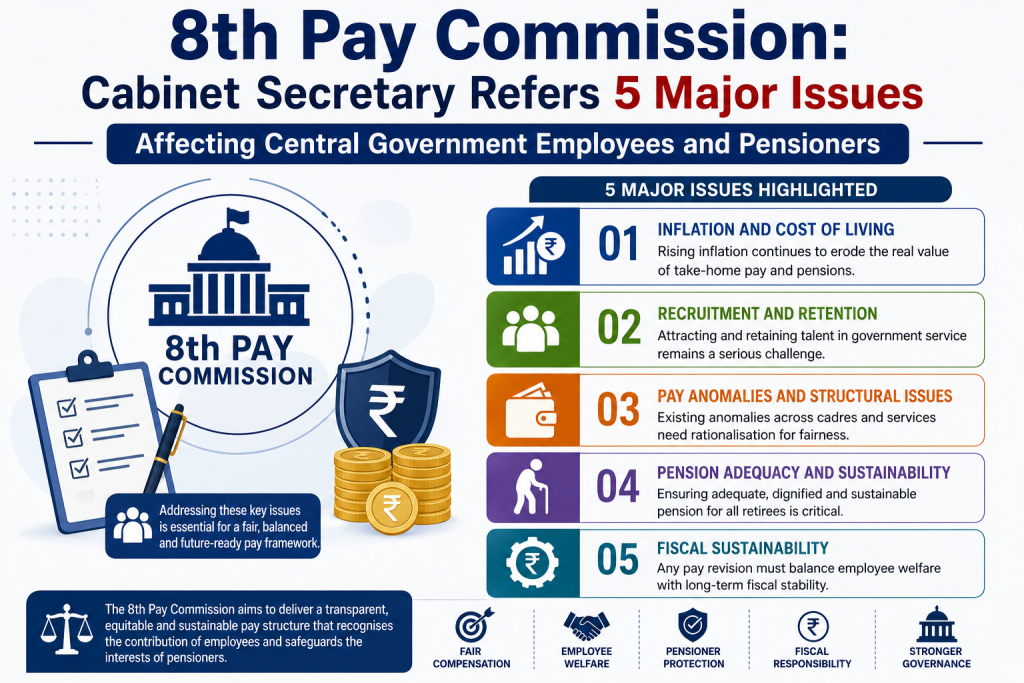

The 8th Pay Commission has entered a crucial phase after the Cabinet Secretary recommended that five major issues concerning Central Government employees and pensioners be referred to the Commission for examination. The recommendations emerged during the 49th meeting of the National Council–Joint Consultative Machinery (NC-JCM), where employee representatives raised several long-pending concerns related to salaries, pensions, and employee welfare.
The development has generated significant interest among lakhs of Central Government employees and pensioners, as these issues could influence the Commission’s final recommendations on pay revision, pension reforms, and service conditions. While no final decisions have been taken yet, the referral indicates that these matters will receive formal consideration during the Commission’s review process.
With consultations continuing across different employee associations and government departments, the 8th Pay Commission remains one of the most closely watched policy developments in India.
Key Highlights
- The Cabinet Secretary has referred five major employee and pension-related issues to the 8th Pay Commission for consideration.
- The recommendations emerged during the 49th NC-JCM meeting.
- Pension reforms remain one of the primary focus areas.
- Family pension, pay parity, and employee welfare issues are under review.
- Pay fixation after promotion under the MACP scheme may also be examined.
- Maternity-related benefits for women employees have been included for consideration.
- Employee associations continue submitting additional recommendations.
- The Commission is conducting consultations with stakeholders before preparing its final report.
10 8th Pay Commission Facts You Should Know
- The 8th Pay Commission will review salaries, pensions, and allowances of Central Government employees.
- Millions of serving employees and pensioners are expected to be affected by its recommendations.
- The current discussions include both employee welfare and pension reforms.
- The NC-JCM represents employee organizations during consultations with the government.
- Pension revision remains one of the most anticipated issues.
- Fitment factor recommendations are yet to be finalized.
- Employee associations continue demanding higher minimum pay and improved allowances.
- Ministries recently completed submission of data required for the Commission’s review process.
- Multiple rounds of consultations with employee unions are scheduled before final recommendations.
- The Commission’s recommendations will ultimately require government approval before implementation.
The Five Major Issues Referred to the 8th Pay Commission
1. Five-Yearly Pension Revision
One of the most important recommendations relates to revising pensions every five years rather than waiting for the next Pay Commission.
Employee representatives argued that periodic pension enhancement would better protect retired employees from inflation and rising living costs.
The Cabinet Secretary recommended referring this issue to the 8th Pay Commission for detailed examination.
2. Higher Family Pension
Another significant issue concerns family pension.
Employee representatives requested that the family pension should not automatically reduce to 30% of the notional pay after a specified period.
The matter has now been referred to the Commission for further consideration.
3. Pay Scale Parity for Firefighting Staff
The Staff Side requested pay parity between Central Government firefighting personnel and the Delhi Fire Service.
The Cabinet Secretary directed that this demand be examined and referred to the 8th Pay Commission if appropriate.
4. Pay Fixation After Promotion Under MACP
Employee organizations also raised concerns regarding employees promoted after receiving benefits under the Modified Assured Career Progression (MACP) Scheme.
They requested pay fixation benefits under existing service rules.
The issue will be examined further before being considered by the Commission.
5. Maternity Benefits for Women Employees
The implementation of provisions under the Maternity Benefit Act for women Central Government employees was also discussed.
The Cabinet Secretary recommended that the matter be examined and referred to the Commission if necessary.
Why These Issues Matter
These recommendations extend beyond salary revision and focus on long-term employee welfare.
If accepted, they could lead to improvements in:
- Pension security
- Family welfare
- Career progression
- Gender-inclusive workplace policies
- Service conditions
The outcome may influence future government employment policies for years to come.
What Employees Are Expecting
Apart from the five issues, employee organizations continue advocating for:
- Higher minimum basic pay
- Revised fitment factor
- Dearness Allowance-related reforms
- Improved House Rent Allowance
- Better retirement benefits
- Pension revisions for existing retirees
These proposals are expected to be discussed during the Commission’s upcoming consultations.
Current Status of the 8th Pay Commission
The Commission is currently gathering inputs from ministries, departments, employee unions, and pensioner organizations.
A key milestone was the June 30 deadline for ministries and departments to submit required data for the pay review exercise, which will form the basis for future recommendations.
Further consultations with employee associations are expected before recommendations are finalized.
Economic Impact
Implementation of the 8th Pay Commission could have broad economic implications.
Higher salaries and pensions generally increase:
- Consumer spending
- Housing demand
- Automobile sales
- Retail consumption
- Banking activity
- Insurance investments
Previous Pay Commissions have significantly influenced domestic economic activity through higher disposable incomes.
Future Outlook
The coming months will be crucial as the Commission continues consultations with employee groups and government departments.
Several major decisions are still awaited, including:
- Revised salary structure
- Fitment factor
- Pension reforms
- Allowance revisions
- Employee welfare measures
While the five referred issues have not yet been approved, their inclusion in the Commission’s agenda indicates that they will receive formal evaluation before the final recommendations are submitted.
Conclusion
The Cabinet Secretary’s decision to refer five important issues affecting Central Government employees and pensioners to the 8th Pay Commission marks another significant step in the pay revision process. Pension enhancement, family pension reforms, pay parity, career progression, and maternity benefits have now become part of the Commission’s broader review agenda.
Although no final decisions have been announced, these discussions demonstrate the government’s willingness to examine long-standing employee concerns alongside salary revisions. As consultations continue, millions of employees and pensioners will closely monitor the Commission’s recommendations, which are expected to shape compensation and welfare policies for the coming decade.