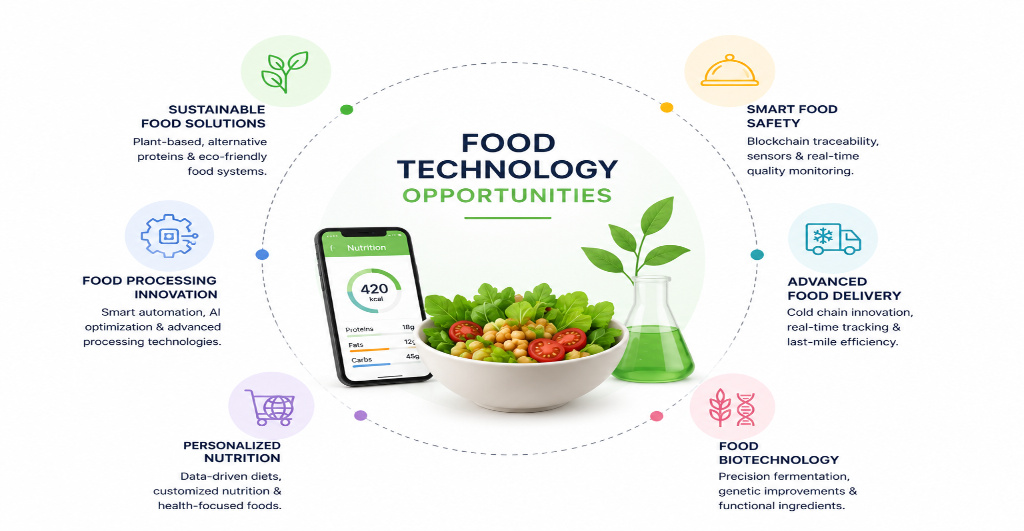

The global food industry is undergoing one of its biggest transformations in history. Driven by advances in artificial intelligence, biotechnology, automation, sustainable agriculture, and digital supply chains, food technology opportunities are expanding across every stage of the food value chain. From smart farming and precision fermentation to personalized nutrition and AI-powered food manufacturing, technology is reshaping how food is produced, processed, distributed, and consumed.
Growing global populations, changing consumer preferences, climate change, and increasing demand for sustainable food systems are encouraging governments, startups, and multinational food companies to invest heavily in next-generation food technologies. As a result, food tech has become one of the fastest-growing innovation sectors, offering enormous opportunities for entrepreneurs, investors, manufacturers, and technology providers.
Why Food Technology Is Becoming a High-Growth Industry
The demand for healthier, safer, and more sustainable food products is increasing worldwide. Consumers now expect transparency in food sourcing, environmentally responsible production methods, and convenient digital purchasing experiences. At the same time, food manufacturers face challenges such as labor shortages, supply chain disruptions, rising production costs, and stricter food safety regulations.
Technology is helping address these issues through automation, artificial intelligence, robotics, blockchain, and biotechnology. Companies adopting these innovations are improving operational efficiency while delivering higher-quality products to consumers.
As investment in agricultural and food innovation accelerates, the sector is creating significant business opportunities across developed and emerging markets.
Key Food Technology Opportunities Transforming the Industry
AI-Powered Food Manufacturing
Artificial intelligence is revolutionizing food production by optimizing manufacturing processes, improving quality control, and predicting equipment maintenance. AI systems analyze production data in real time to reduce waste, improve consistency, and maximize operational efficiency.
Food manufacturers are also using AI to forecast consumer demand, optimize inventory, and develop new products based on changing market trends. These capabilities help companies reduce costs while accelerating innovation.
Alternative Proteins and Precision Fermentation
One of the fastest-growing food technology opportunities lies in alternative protein production. Consumers are increasingly seeking plant-based, cultivated, and fermentation-derived proteins due to health, environmental, and ethical considerations.
Precision fermentation enables companies to produce high-value proteins, enzymes, dairy ingredients, and functional food compounds with greater efficiency than traditional production methods. Continued investment in this area is expected to reshape the global protein market over the coming decade.
Smart Agriculture
Modern farming is becoming increasingly data-driven. Farmers now use drones, IoT sensors, satellite imaging, autonomous tractors, and AI-powered analytics to monitor crop health, optimize irrigation, and improve fertilizer application.
Precision agriculture reduces resource consumption while increasing crop yields and profitability. As climate variability intensifies, smart farming technologies will become essential for ensuring global food security.
Food Delivery and Cloud Kitchens
The rapid expansion of online food delivery platforms has created new opportunities for technology-enabled restaurant operations. Cloud kitchens, also known as ghost kitchens, rely entirely on digital ordering platforms without traditional dine-in facilities.
AI-driven demand forecasting, automated order management, and delivery optimization help businesses improve efficiency while serving growing urban populations.
Blockchain for Food Traceability
Food safety and transparency have become top priorities for consumers and regulators. Blockchain technology allows companies to record every stage of the food supply chain, from farm to consumer.
This creates tamper-resistant records that improve traceability, reduce food fraud, simplify recalls, and strengthen consumer confidence. Retailers and food brands increasingly view blockchain as a valuable competitive advantage.
Personalized Nutrition
Consumers are moving away from one-size-fits-all diets toward personalized nutrition based on genetics, health conditions, and lifestyle preferences.
Digital health platforms, wearable devices, and AI-powered nutrition analysis enable companies to recommend customized meal plans, supplements, and functional foods. This growing market presents significant opportunities for healthcare providers, food manufacturers, and nutrition technology companies.
Sustainable Food Packaging
Sustainability remains one of the strongest drivers of innovation across the food industry. Companies are investing in biodegradable packaging, edible coatings, recyclable materials, and smart packaging technologies that extend shelf life while reducing environmental impact.
Smart packaging equipped with freshness indicators and QR codes also improves product transparency and consumer engagement.
Robotics and Automation
Automation is addressing labor shortages while improving productivity across food processing facilities. Robotic systems perform packaging, sorting, inspection, palletizing, and quality control with greater speed and accuracy than manual operations.
Collaborative robots (cobots) are increasingly working alongside human employees to improve workplace safety and production efficiency.
Digital Grocery and E-Commerce
Online grocery shopping continues to reshape consumer purchasing behavior. Retailers are investing in AI-powered recommendation engines, automated fulfillment centers, cashier-less stores, and predictive inventory management.
The integration of mobile applications, digital payments, and personalized promotions is creating seamless shopping experiences while opening new revenue opportunities for retailers.
Investment Opportunities in Food Technology
The food technology sector is attracting significant venture capital and corporate investment worldwide. High-growth opportunities include:
- Alternative protein startups
- Precision fermentation companies
- Agricultural robotics
- AI-powered food manufacturing
- Vertical farming solutions
- Food waste reduction technologies
- Smart packaging innovations
- Digital grocery platforms
- Blockchain food traceability solutions
- Personalized nutrition platforms
These segments are expected to experience strong long-term growth as global demand for sustainable and technology-enabled food systems continues to rise.
Challenges Facing the Industry
Despite rapid innovation, food technology companies must overcome several challenges. High research and development costs, regulatory approval processes, consumer acceptance of novel foods, cybersecurity risks, and infrastructure limitations can slow commercialization.
Maintaining affordability while scaling advanced food technologies will also be critical for achieving widespread adoption across global markets.
The Future of Food Technology
The future of food technology will focus on creating smarter, healthier, and more sustainable food ecosystems. Artificial intelligence, biotechnology, automation, and digital platforms will continue transforming how food is produced and consumed.
Companies that invest early in innovation, sustainability, and digital transformation are likely to gain a competitive advantage as consumer expectations continue evolving. With increasing investment and supportive government initiatives, food technology opportunities will remain one of the most promising growth areas within the global innovation economy.