
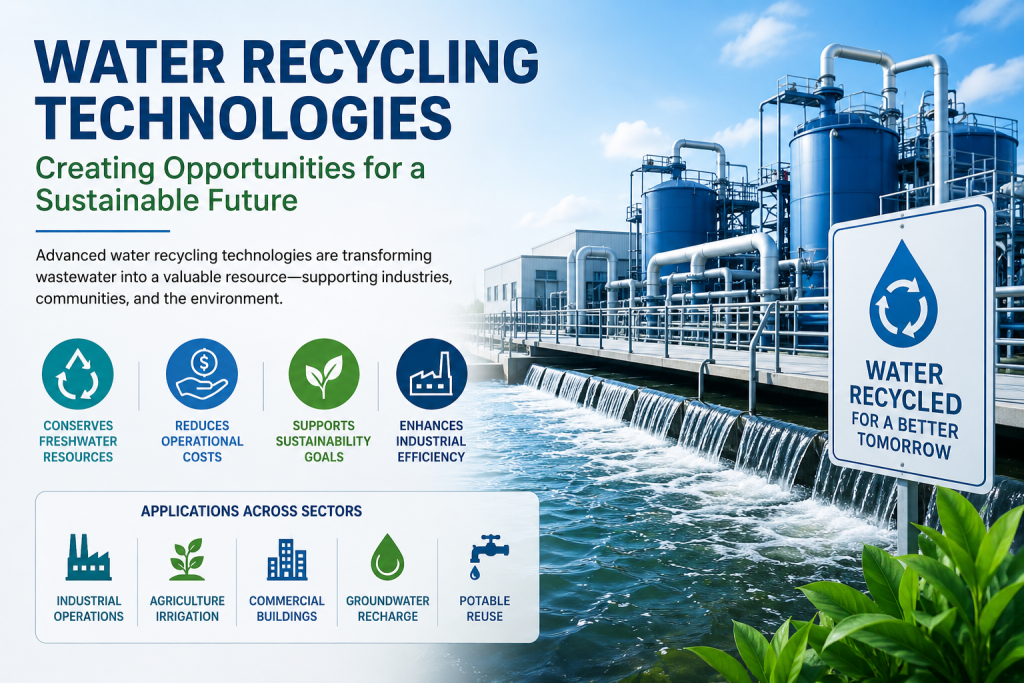

Water has become one of the world’s most valuable natural resources, and growing concerns over water scarcity are driving the rapid adoption of water recycling technologies. Rising urbanization, industrial growth, climate change, and increasing freshwater demand are encouraging governments and businesses to invest in advanced water treatment and reuse solutions. As industries seek sustainable ways to manage water resources, water recycling technologies are emerging as a critical component of future infrastructure development.
Modern water recycling systems use advanced filtration, membrane technology, reverse osmosis, ultraviolet disinfection, and biological treatment processes to convert wastewater into reusable water. These solutions help industries, municipalities, and commercial facilities reduce freshwater consumption, lower operating costs, and comply with increasingly stringent environmental regulations. As sustainability becomes a global priority, the demand for efficient water recycling technologies continues to expand across multiple sectors.
Industry estimates indicate that the global water recycling market is expected to witness strong growth throughout the next decade, supported by increasing investments in sustainable infrastructure, stricter wastewater management policies, and rising awareness about responsible water conservation.
Key Highlights
- Water scarcity is accelerating the adoption of advanced water recycling technologies worldwide.
- Governments are introducing stricter wastewater regulations to promote water reuse.
- Industries are investing in closed-loop water management systems to improve operational efficiency.
- Advanced filtration, reverse osmosis, and UV disinfection technologies continue to improve recycling performance.
- Smart monitoring and automation are enhancing the efficiency of modern water treatment facilities.
- Asia-Pacific remains one of the fastest-growing regions for water recycling infrastructure.
Growing Water Scarcity Creates New Market Opportunities
The increasing pressure on global freshwater resources has made water recycling an essential strategy for long-term water security. Population growth, rapid urbanization, changing climate patterns, and industrial expansion continue to increase water demand while reducing the availability of natural freshwater sources.
To address these challenges, governments and private organizations are investing heavily in wastewater treatment facilities, recycled water distribution networks, and sustainable water management programs. These developments are creating significant opportunities for technology providers, engineering firms, equipment manufacturers, and environmental service companies.
Industrial Adoption Continues to Accelerate
Water-intensive industries such as manufacturing, food and beverage, pharmaceuticals, mining, chemicals, semiconductors, and power generation are increasingly implementing advanced water recycling systems. Reusing treated wastewater enables businesses to reduce dependence on freshwater supplies while improving operational resilience.
Industrial water recycling also helps organizations meet environmental compliance requirements, lower water procurement costs, and strengthen corporate sustainability initiatives. As environmental standards continue to evolve, demand for industrial water reuse solutions is expected to rise steadily.
Technological Innovation Is Transforming Water Recycling
Continuous technological advancements are improving the performance, reliability, and affordability of water recycling systems. Modern treatment plants now integrate membrane filtration, reverse osmosis, ultraviolet disinfection, advanced oxidation processes, and intelligent monitoring systems to deliver higher water quality with greater efficiency.
Automation, digital sensors, and AI-powered monitoring platforms are enabling real-time system optimization, predictive maintenance, and improved resource management. These innovations are helping operators reduce energy consumption while maximizing water recovery rates.
Sustainability Initiatives Drive Investment
Environmental sustainability has become a major priority for both governments and private enterprises. Organizations are increasingly incorporating recycled water into their sustainability strategies to reduce water consumption, minimize environmental impact, and support circular economy initiatives.
Growing investments in green infrastructure, public-private partnerships, and environmentally responsible industrial practices are expected to create substantial business opportunities for companies specializing in water recycling technologies.
Asia-Pacific Emerges as a High-Growth Market
Asia-Pacific is expected to remain one of the most dynamic markets for water recycling technologies due to rapid industrialization, expanding urban populations, and increasing investments in water infrastructure. Countries across the region are strengthening wastewater treatment capacity to improve long-term water availability.
North America and Europe continue to focus on modernizing aging water infrastructure and expanding industrial water reuse projects, while water-stressed regions in the Middle East are accelerating investments in advanced recycling technologies to enhance water security.
Future Outlook
The future of water recycling technologies is closely linked to global sustainability goals and the growing need for resilient water infrastructure. Continued innovation in filtration systems, smart water management platforms, energy-efficient treatment processes, and digital monitoring solutions will further strengthen market growth.
As industries and municipalities prioritize responsible water management, water recycling technologies will become an increasingly important solution for conserving freshwater resources while supporting economic development and environmental protection.
Conclusion
Water recycling technologies are rapidly becoming a cornerstone of sustainable infrastructure development. Rising water scarcity, stricter environmental regulations, and increasing industrial demand are driving widespread adoption across the globe.
With continuous technological innovation, supportive government policies, and growing corporate sustainability commitments, the market is expected to create significant opportunities for investors, technology providers, and infrastructure developers. As the world moves toward more efficient resource management, water recycling technologies will play a vital role in building a more sustainable and water-secure future.