
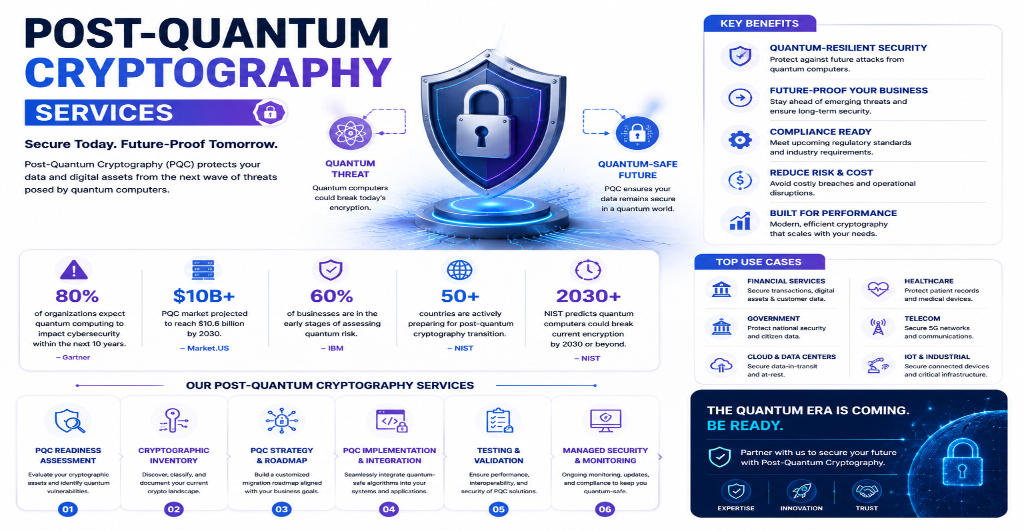

The rapid advancement of quantum computing is poised to transform industries ranging from healthcare and finance to scientific research and artificial intelligence. However, this technological breakthrough also presents one of the most significant cybersecurity challenges in modern history. Powerful quantum computers have the potential to break many of today’s widely used public-key encryption algorithms, putting sensitive data, financial systems, government communications, and critical infrastructure at risk. As organizations prepare for this inevitable shift, Post-Quantum Cryptography Services are emerging as a critical component of future-proof cybersecurity strategies.
Post-Quantum Cryptography (PQC) focuses on developing and implementing cryptographic algorithms that remain secure against attacks from both classical and quantum computers. Governments, technology companies, financial institutions, and cloud providers are investing heavily in quantum-resistant encryption to safeguard digital assets before large-scale quantum computers become commercially available. As cyber threats evolve, organizations are recognizing that preparing today is essential for protecting tomorrow’s data.
What Are Post-Quantum Cryptography Services?
Post-Quantum Cryptography Services are specialized cybersecurity solutions designed to help organizations transition from traditional encryption methods to quantum-resistant cryptographic algorithms. These services include cryptographic assessments, migration planning, algorithm implementation, security testing, key management, compliance consulting, and ongoing monitoring.
Unlike quantum cryptography, which relies on quantum physics for secure communication, Post-Quantum Cryptography uses advanced mathematical algorithms that can operate on existing computer systems while resisting attacks from future quantum computers. This makes PQC a practical and scalable solution for organizations seeking long-term cybersecurity resilience.
Why Post-Quantum Cryptography Is Becoming Essential
Today’s internet security depends largely on encryption algorithms such as RSA, Diffie-Hellman, and Elliptic Curve Cryptography (ECC). These cryptographic standards protect online banking, cloud computing, digital signatures, government communications, healthcare records, and countless other digital services.
Quantum computers running Shor’s algorithm could eventually solve the mathematical problems underlying these encryption methods, rendering them ineffective. Even though large-scale quantum computers capable of breaking modern encryption are still under development, cybercriminals may already be collecting encrypted information with the intention of decrypting it once quantum technology matures. This “harvest now, decrypt later” strategy has accelerated the urgency for organizations to adopt Post-Quantum Cryptography Services.
Key Services Offered by PQC Providers
Post-Quantum Cryptography Services cover every stage of an organization’s transition toward quantum-safe security.
Organizations typically begin with cryptographic risk assessments that identify vulnerable encryption systems across networks, applications, cloud environments, databases, and communication platforms. Experts then develop migration roadmaps to prioritize upgrades while minimizing operational disruption.
Implementation services involve integrating quantum-resistant algorithms into existing software, authentication systems, VPNs, email security, digital certificates, and enterprise applications. Security testing validates the effectiveness of these implementations under real-world conditions.
Many providers also offer cryptographic agility solutions, allowing organizations to switch encryption algorithms quickly as standards evolve. Continuous monitoring, compliance support, employee training, and managed security services further strengthen long-term protection against emerging quantum threats.
Industries Driving Adoption
Financial institutions are among the earliest adopters of Post-Quantum Cryptography Services due to the enormous value of sensitive financial transactions and customer data. Banks, payment processors, insurance companies, and investment firms require long-term confidentiality for digital assets.
Government agencies and defense organizations are investing heavily in quantum-safe encryption to protect classified communications, national security systems, and critical infrastructure from future cyberattacks.
Healthcare providers increasingly recognize the importance of safeguarding electronic medical records and research data that may remain sensitive for decades. Similarly, cloud service providers, telecommunications companies, energy utilities, aerospace organizations, and technology firms are accelerating quantum readiness initiatives.
As connected devices continue to expand through the Internet of Things (IoT), manufacturers are also integrating post-quantum security into embedded systems and smart infrastructure.
Emerging Technology Trends
The Post-Quantum Cryptography ecosystem is evolving rapidly alongside advances in cybersecurity and quantum computing.
Many organizations are adopting hybrid cryptographic models that combine classical encryption with quantum-resistant algorithms during the transition period. This approach ensures compatibility while gradually improving security.
Cloud providers are beginning to integrate quantum-safe encryption into managed security services, enabling enterprises to adopt new standards without rebuilding entire infrastructures. Zero Trust architectures are increasingly incorporating post-quantum authentication mechanisms to strengthen identity verification.
Artificial intelligence is also playing a growing role by automating cryptographic inventory discovery, vulnerability analysis, and migration planning across complex enterprise environments.
Meanwhile, global standardization efforts are helping accelerate adoption by providing consistent frameworks for secure implementation and interoperability.
Challenges to Adoption
Despite growing momentum, implementing Post-Quantum Cryptography Services presents several challenges.
Many enterprise environments contain legacy systems that were never designed for cryptographic flexibility, making upgrades both technically complex and resource-intensive. Organizations must carefully balance security improvements with business continuity.
Performance considerations also remain important, as some quantum-resistant algorithms require larger encryption keys or greater computational resources compared to traditional methods. Integration across diverse software ecosystems may require significant testing and optimization.
The rapidly evolving nature of quantum research also means organizations need flexible strategies that can adapt as standards and best practices continue to mature.
Future Outlook
The future of Post-Quantum Cryptography Services is expected to be shaped by increasing regulatory requirements, growing cybersecurity investments, and accelerating quantum computing innovation. As organizations recognize the long-term risks posed by quantum-enabled cyberattacks, demand for quantum-resistant security solutions will continue to expand across both public and private sectors.
Cybersecurity vendors are developing more automated migration platforms, managed quantum-readiness services, and AI-driven cryptographic management tools that simplify adoption for enterprises of all sizes. Governments worldwide are also encouraging organizations to begin transitioning toward approved post-quantum standards well before quantum computers become capable of compromising existing encryption.
Organizations that proactively adopt Post-Quantum Cryptography Services today will be better positioned to maintain trust, regulatory compliance, and long-term data protection in the quantum era.
Conclusion
Post-Quantum Cryptography Services represent one of the most important developments in modern cybersecurity. As quantum computing advances, traditional encryption methods will face unprecedented challenges, making quantum-resistant cryptography essential for protecting sensitive information and digital infrastructure.
By investing in Post-Quantum Cryptography Services, organizations can strengthen cybersecurity resilience, reduce future risks, and prepare confidently for the next generation of computing. As digital transformation continues to accelerate, quantum-safe security will become a fundamental requirement for safeguarding the connected world.