
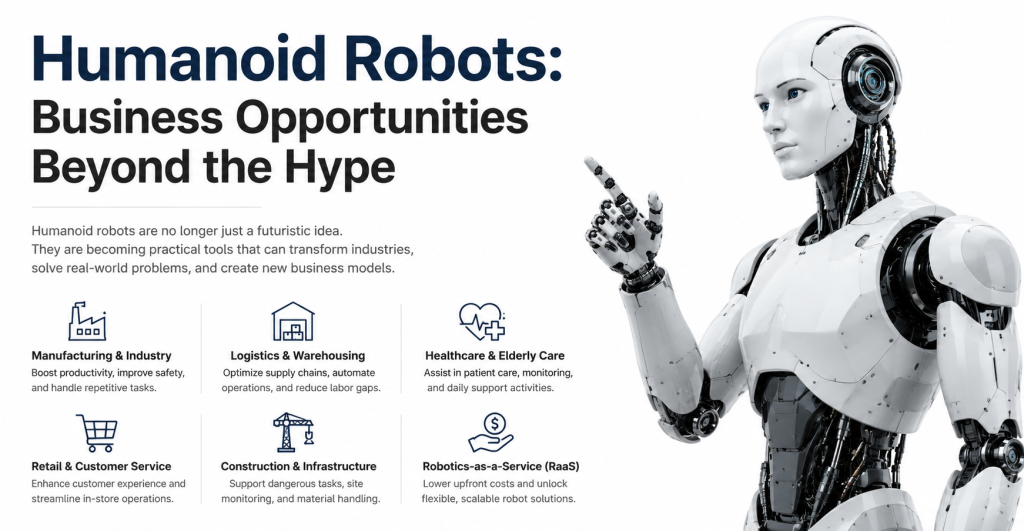

The Rise of Machines That Work Like Humans
Every major technological revolution begins with skepticism. Personal computers were once considered unnecessary for households. Smartphones were viewed as luxury gadgets. Artificial intelligence was often dismissed as a futuristic concept with limited practical value.
Humanoid robots are now experiencing a similar phase.
While many people associate humanoid robots with flashy demonstrations and viral videos, businesses are increasingly exploring how these machines can solve real operational challenges. The combination of advanced AI, improved robotics hardware, and declining technology costs is creating conditions for a new era of automation.
The global economy is facing labor shortages, rising operational costs, and growing productivity demands. Humanoid robots may offer a solution that bridges these gaps while opening new business opportunities across multiple industries.
The real opportunity is not simply building robots. It is creating an ecosystem of products, services, software, and infrastructure around them.
Why Businesses Are Paying Attention
Traditional industrial robots have been used in factories for decades. However, these machines are usually designed for specific tasks and often require dedicated environments.
Humanoid robots are different.
Because they resemble human workers in size and movement, they can potentially operate in workplaces designed for people. They can use existing tools, navigate standard workspaces, and perform a variety of tasks without extensive modifications to infrastructure.
This flexibility makes them attractive to businesses looking for automation solutions without completely redesigning their facilities.
At the same time, advances in artificial intelligence are making robots more capable of understanding instructions, adapting to changing environments, and collaborating with human workers.
Addressing the Global Labor Shortage
One of the strongest drivers behind humanoid robot adoption is the growing labor shortage affecting many industries. Manufacturing companies struggle to fill repetitive production roles. Warehouses face high employee turnover. Healthcare providers face increasing staffing pressures. Construction firms encounter shortages of skilled workers.
In many regions, aging populations are reducing the available workforce while demand for goods and services continues to rise. Humanoid robots can help organizations maintain productivity levels without relying entirely on human labor. They can perform physically demanding tasks, operate in hazardous conditions, and work extended hours without fatigue.
For businesses facing recruitment challenges, robotic workers may become a strategic advantage rather than a technological novelty.
The Warehouse Revolution
Warehousing and logistics represent one of the most immediate opportunities for humanoid robots. E-commerce growth has transformed consumer expectations. Customers now demand faster deliveries, accurate order fulfillment, and round-the-clock service.
Meeting these expectations requires highly efficient warehouse operations.
Humanoid robots can assist with inventory movement, order picking, package sorting, and facility inspections. Because warehouses are often designed around human workflows, humanoid robots may integrate more easily than specialized robotic systems.
Businesses that provide warehouse automation software, robotic deployment services, maintenance support, and AI-driven logistics platforms could benefit from increasing demand. The warehouse of the future may include a combination of human workers and robotic assistants operating together to maximize efficiency.
Healthcare’s Untapped Potential
Healthcare is another sector where humanoid robots could create substantial value.
Hospitals and care facilities spend significant resources on routine tasks that do not necessarily require medical expertise. Transporting supplies, delivering medications, monitoring patients, and assisting with administrative duties consume valuable staff time.
Humanoid robots can help reduce this burden.
In elderly care environments, robots may assist with daily activities, provide reminders, monitor health conditions, and support caregivers. As populations continue to age worldwide, demand for such solutions is expected to increase significantly.
The opportunity extends beyond robotics manufacturers. Healthcare software developers, remote monitoring providers, AI analytics companies, and robotic service organizations may all participate in this expanding market.
New Opportunities in Retail and Hospitality
Customer service industries are constantly searching for ways to improve efficiency while maintaining high service standards. Humanoid robots can welcome guests, answer questions, provide directions, manage check-ins, and assist customers with routine inquiries. Hotels, airports, shopping malls, and entertainment venues may increasingly adopt robotic assistants to enhance customer experiences.
As natural language processing and conversational AI technologies improve, these robots will become more capable of handling complex interactions. This creates opportunities for businesses specializing in customer engagement software, multilingual AI systems, robotic training platforms, and service automation solutions.
The Software Opportunity May Be Bigger Than Hardware
Many investors focus on robot manufacturers, but the software layer may ultimately generate even greater value. Every humanoid robot requires advanced operating systems, machine learning models, navigation software, computer vision capabilities, and cybersecurity protection.
The demand for robotic software ecosystems is expected to grow alongside hardware adoption. Companies developing robotic operating platforms, AI training systems, simulation environments, and cloud-based robot management solutions could emerge as major beneficiaries.
Just as smartphones created opportunities far beyond device manufacturing, humanoid robots may create a vast software economy supporting millions of connected machines.
Robotics-as-a-Service Changes the Game
Cost remains one of the biggest obstacles to widespread adoption. Many businesses cannot justify purchasing expensive robotic systems outright. This challenge is driving interest in Robotics-as-a-Service (RaaS). Under this model, organizations subscribe to robotic capabilities rather than buying robots directly. Service providers handle maintenance, software updates, repairs, and operational support. This approach lowers financial barriers while creating predictable recurring revenue streams. For startups and investors, RaaS may become one of the most attractive business models within the robotics industry.
Challenges That Remain
Despite significant progress, humanoid robots are not yet ready to replace large portions of the workforce. Technical limitations still exist. Robots must become more reliable, more affordable, and better at operating in dynamic environments. Safety regulations, public acceptance, workforce integration, and cybersecurity concerns will also influence adoption rates. Companies entering this space must recognize that commercialization will likely occur gradually rather than overnight. Success will depend on solving practical business problems rather than pursuing technological spectacle.
Looking Ahead
Humanoid robots represent more than a technological achievement. They represent a potential transformation in how work is performed across industries. The most successful businesses will not necessarily be those building the robots themselves. Instead, the winners may include software developers, AI providers, infrastructure companies, service operators, maintenance specialists, and industry-specific solution providers.
As organizations seek new ways to improve productivity, manage labor shortages, and remain competitive, humanoid robots are moving from experimental technology to strategic business asset.
The hype surrounding humanoid robots may eventually fade, but the business opportunities they create could endure for decades. For entrepreneurs, investors, and technology leaders, this may be one of the most important innovation trends to watch in the years ahead.