
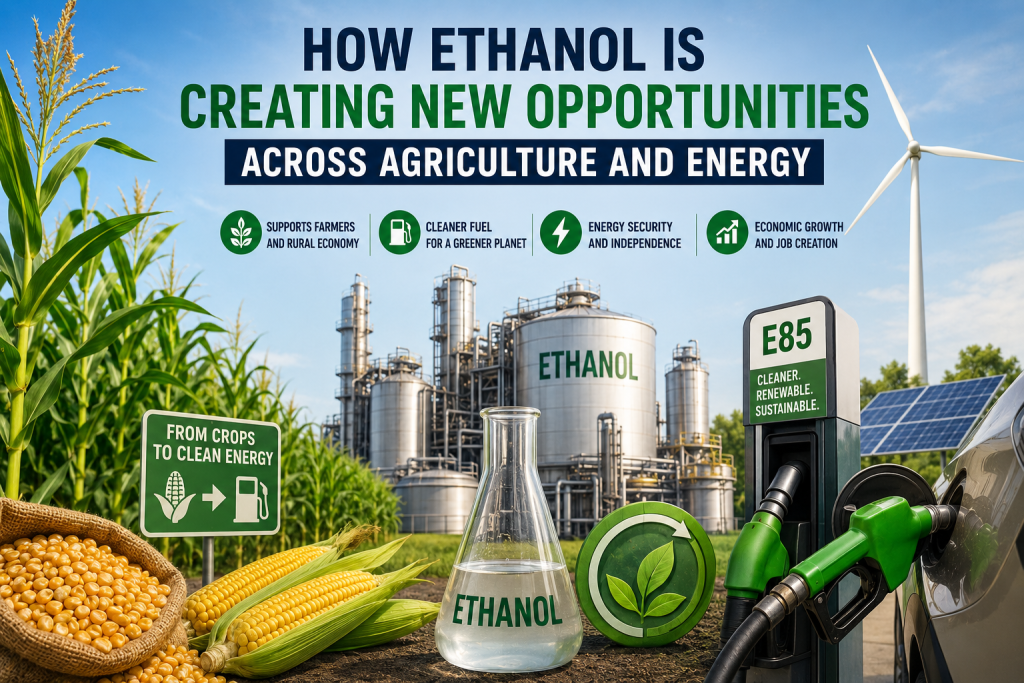

The global shift toward cleaner energy and sustainable development is creating new opportunities for ethanol across both the agriculture and energy sectors. As governments, businesses, and consumers seek alternatives to fossil fuels, ethanol has emerged as a renewable solution that not only helps reduce greenhouse gas emissions but also supports farmers, strengthens rural economies, and enhances energy security. From increasing demand for agricultural feedstocks to advancing biofuel technologies, ethanol is becoming a key driver of economic growth and environmental sustainability.
Ethanol: A Renewable Fuel with Growing Importance
Ethanol is a biofuel primarily produced from renewable feedstocks such as corn, sugarcane, wheat, and agricultural residues. Unlike conventional fossil fuels, ethanol is derived from biological materials that can be replenished through farming and biomass cultivation. It is commonly blended with gasoline to reduce emissions and improve fuel efficiency, making it an essential component of many national clean energy strategies.
As countries continue to adopt renewable fuel policies and higher ethanol blending targets, the demand for ethanol is expanding worldwide. This growth is opening new opportunities across agriculture, manufacturing, transportation, and renewable energy industries.
Strengthening Agricultural Economies
One of ethanol’s greatest contributions lies in its positive impact on agriculture. Farmers benefit from increased demand for crops used in ethanol production, creating more stable markets and improving farm incomes. Corn and sugarcane remain the primary feedstocks in many regions, while interest in alternative crops and biomass sources continues to grow.
The expansion of ethanol production encourages investment in agricultural infrastructure, storage facilities, irrigation systems, and modern farming techniques. These developments improve productivity while supporting rural employment and local economic development.
In addition, ethanol production generates valuable by-products such as distillers grains, which are widely used as nutritious livestock feed. This creates additional revenue streams for producers and contributes to a more efficient agricultural value chain.
Expanding Opportunities Through Advanced Biofuels
Innovation is transforming the ethanol industry beyond traditional feedstocks. Second-generation (2G) ethanol, produced from agricultural waste, crop residues, forestry by-products, and non-food biomass, is gaining momentum as a sustainable alternative to conventional biofuels.
Using agricultural waste materials helps reduce environmental impact while creating additional income opportunities for farmers who can supply residues that were previously discarded or burned. This approach supports waste reduction, promotes resource efficiency, and strengthens the circular economy.
Advanced fermentation technologies and improved biomass conversion processes are making second-generation ethanol increasingly commercially viable, attracting investments from governments and private companies alike.
Supporting Energy Security
Ethanol plays an important role in improving national energy security by reducing dependence on imported crude oil. Countries with strong agricultural sectors can produce ethanol domestically, helping diversify energy supplies and reduce vulnerability to fluctuations in global oil prices.
Expanding domestic ethanol production also enhances fuel availability while supporting long-term energy resilience. As geopolitical uncertainties continue to affect global energy markets, renewable fuels like ethanol provide greater stability and supply flexibility.
Many governments are encouraging higher ethanol blending levels in transportation fuels to strengthen domestic energy independence while reducing carbon emissions.
Driving Investment Across the Energy Sector
Growing demand for ethanol is encouraging investments throughout the renewable energy value chain. Companies are expanding ethanol production facilities, modernizing existing bio-refineries, and investing in advanced processing technologies to improve efficiency and sustainability.
Infrastructure development is also accelerating. New storage terminals, transportation networks, blending facilities, and distribution systems are being built to support rising ethanol consumption. These investments create employment opportunities across engineering, logistics, construction, and manufacturing industries.
Financial institutions and private investors increasingly recognize renewable fuels as long-term growth opportunities, further boosting capital flows into ethanol-related projects.
Innovation and Digital Transformation
Technology is reshaping modern ethanol production. Automation, artificial intelligence, machine learning, and advanced process monitoring systems help producers optimize operations, reduce production costs, improve energy efficiency, and maintain consistent product quality.
Many ethanol plants are also adopting carbon capture technologies to reduce emissions generated during production. Captured carbon dioxide can be utilized in industrial applications or permanently stored, making ethanol production even more environmentally sustainable.
Research into enzyme technologies, precision fermentation, and genetically improved feedstocks continues to increase production efficiency while reducing environmental impact.
Environmental Benefits and Sustainability
Ethanol contributes significantly to reducing greenhouse gas emissions compared to conventional gasoline. Higher ethanol blends produce fewer harmful pollutants, supporting cleaner air and improved environmental health.
The increasing use of agricultural residues for ethanol production further enhances sustainability by minimizing waste and reducing open-field burning. Combined with renewable electricity and carbon capture technologies, ethanol production is becoming an increasingly low-carbon industry.
These environmental benefits align with global climate commitments and support national strategies for achieving net-zero emissions.
Future Outlook
The future of ethanol looks increasingly promising as governments strengthen renewable fuel policies and industries seek cleaner energy solutions. Advances in second-generation ethanol, carbon capture, digital manufacturing, and sustainable agriculture are expected to create even greater opportunities across multiple sectors.
Agriculture will continue to benefit from stronger demand for renewable feedstocks, while energy companies invest in cleaner fuels to support decarbonization goals. Collaboration between farmers, technology providers, policymakers, and energy producers will further accelerate innovation and market growth.
As the global transition toward sustainable energy continues, ethanol is positioned to become a critical bridge between agriculture and clean energy. By creating value across farming, manufacturing, transportation, and environmental sustainability, ethanol is helping build a more resilient, diversified, and low-carbon economy for the future.