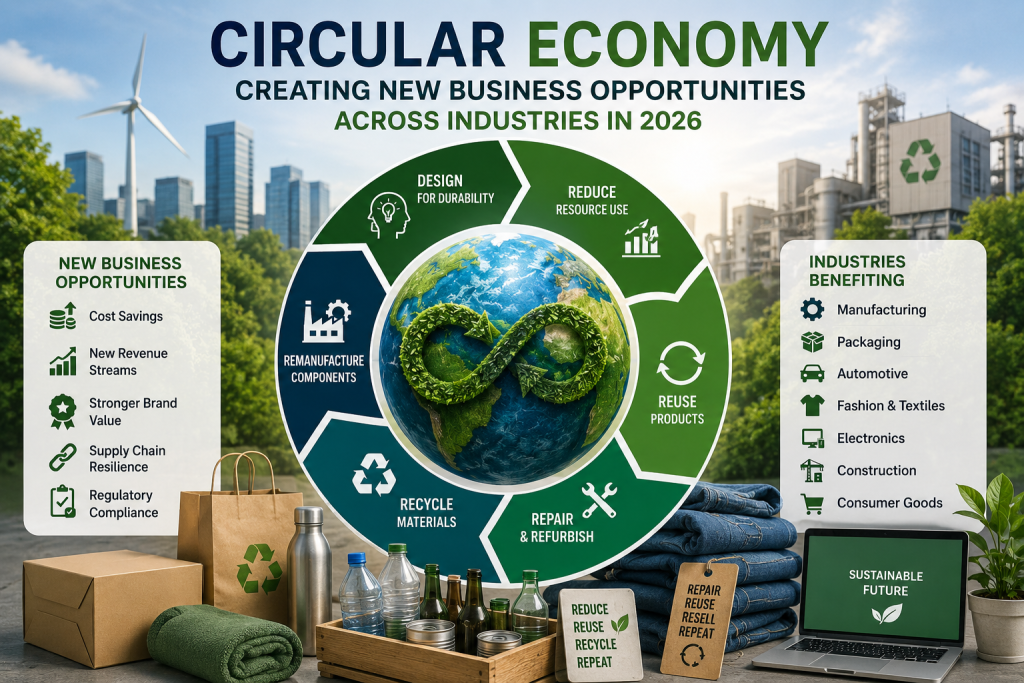

The global business environment is rapidly evolving, and circular economy models are emerging as one of the most significant opportunities for organizations in 2026. Unlike traditional linear business models that follow a “take, make, and dispose” approach, circular economy strategies focus on maximizing resource efficiency by promoting reuse, recycling, refurbishment, and waste reduction.
As businesses face increasing pressure to improve sustainability, reduce costs, and comply with environmental regulations, circular economy initiatives are creating new opportunities across multiple industries. From manufacturing and packaging to fashion and consumer electronics, organizations are discovering innovative ways to generate revenue while minimizing environmental impact.
As sustainability becomes a strategic business priority, circular economy practices are opening new pathways for growth, innovation, and long-term competitiveness.
Expanding Opportunities for Businesses
One of the most significant opportunities created by the circular economy is the ability to develop new business models and revenue streams.
Companies are increasingly shifting from traditional product sales to service-based and subscription models. Product leasing, rental services, and product-as-a-service (PaaS) models allow businesses to maintain ownership of products while generating recurring revenue.
By extending product lifecycles and improving resource utilization, organizations can reduce material costs while creating long-term customer relationships.
Businesses that successfully adopt circular strategies often experience improved profitability, stronger brand value, and enhanced operational resilience.
Creating New Revenue Streams Through Recycling and Remanufacturing
Recycling and remanufacturing activities are generating significant business opportunities across industries.
Organizations are increasingly recovering valuable materials from used products, industrial waste, and end-of-life equipment. These recovered materials can be reintroduced into production processes, reducing dependence on virgin raw materials.
Remanufacturing programs are also gaining momentum, particularly in industries such as automotive, industrial equipment, and electronics. Refurbished products provide businesses with additional revenue opportunities while offering cost-effective alternatives for consumers.
As material costs continue to rise, resource recovery is becoming an increasingly attractive business strategy.
Transforming Manufacturing and Supply Chains
Circular economy principles are reshaping manufacturing operations and supply chain strategies.
Manufacturers are investing in sustainable production processes, closed-loop systems, and waste reduction initiatives to improve efficiency and reduce environmental impact.
Supply chains are becoming more collaborative as organizations work with suppliers, recyclers, and logistics providers to recover materials and optimize product lifecycles.
These initiatives not only support sustainability goals but also improve supply chain resilience by reducing exposure to raw material shortages and price volatility.
Companies adopting circular supply chain practices are often better positioned to manage future market disruptions.
Driving Innovation in Packaging and Consumer Goods
The packaging and consumer goods sectors are witnessing substantial opportunities through circular economy adoption.
Businesses are investing heavily in recyclable, reusable, compostable, and biodegradable packaging solutions to meet evolving consumer expectations and regulatory requirements.
Refillable packaging systems, reusable containers, and packaging take-back programs are creating entirely new business opportunities for manufacturers and retailers.
Growing consumer preference for sustainable products is encouraging brands to innovate and differentiate themselves in highly competitive markets.
Organizations that prioritize sustainable packaging are increasingly strengthening customer loyalty and market positioning.
Creating Opportunities in the Fashion and Electronics Industries
Several industries are particularly benefiting from circular economy business models.
The fashion industry is expanding resale platforms, clothing rental services, repair programs, and textile recycling initiatives to extend product lifecycles and reduce waste.
Similarly, consumer electronics companies are increasingly offering device refurbishment, trade-in programs, repair services, and certified pre-owned products.
These circular initiatives enable businesses to capture additional value from existing products while supporting sustainability objectives.
As consumer awareness continues to grow, demand for circular products and services is expected to increase significantly.
Technology Is Accelerating Circular Business Models
Technology is playing a crucial role in enabling circular economy opportunities.
Digital platforms, Internet of Things (IoT) sensors, blockchain solutions, and advanced analytics are helping businesses track materials, monitor product usage, and optimize resource management.
Smart technologies improve transparency throughout product lifecycles, making it easier for organizations to recover, reuse, and recycle materials efficiently.
Automation and data-driven insights are also supporting more sustainable manufacturing and supply chain operations.
As digital transformation continues, technology-enabled circular ecosystems are expected to expand rapidly across industries.
Supporting Sustainability and Corporate Growth
Circular economy adoption is helping organizations align sustainability goals with long-term business growth.
Companies implementing circular strategies can reduce operational costs, strengthen regulatory compliance, improve brand reputation, and attract environmentally conscious consumers and investors.
Additionally, sustainability-focused initiatives often create opportunities for partnerships, innovation, and market expansion.
Businesses that embrace circular principles early may gain significant competitive advantages as environmental regulations continue to evolve globally.
Challenges Still Remain
Despite the significant opportunities, several challenges continue to influence circular economy adoption.
High implementation costs, limited recycling infrastructure, supply chain complexities, and lack of standardized regulations remain important barriers for many organizations.
Additionally, redesigning products for durability, repairability, and recyclability often requires substantial investment and organizational change.
Businesses must balance sustainability objectives with operational and financial considerations to achieve long-term success.
Looking Ahead
Circular economy models are becoming more than sustainability initiatives—they are creating entirely new business opportunities across global industries.
By enabling innovative business models, generating new revenue streams, improving resource efficiency, and strengthening supply chain resilience, circular economy practices are reshaping the future of business.
Organizations that embrace circular strategies are likely to gain significant competitive advantages in the years ahead. As adoption continues to accelerate throughout 2026 and beyond, circular economy principles are expected to become a cornerstone of sustainable business growth.
For businesses willing to rethink traditional operating models, the circular economy represents one of the most promising opportunities in today’s rapidly evolving global marketplace.