
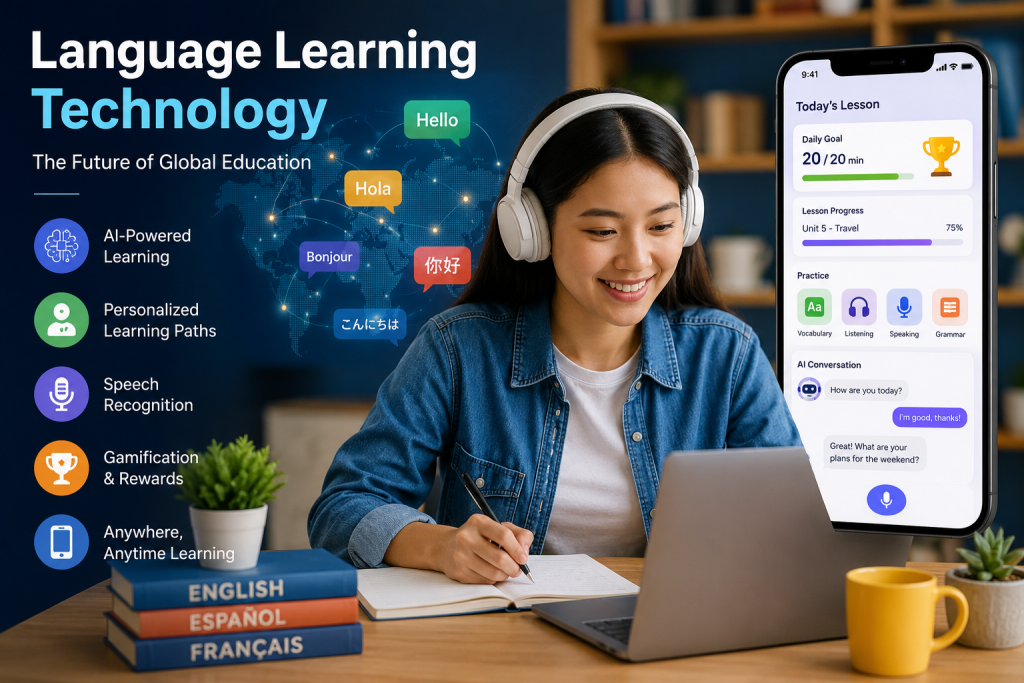

The global education sector is undergoing a significant digital transformation, and one of its fastest-growing segments is language learning technology. As globalization, remote work, international education, and cross-border business continue to expand, learning multiple languages has become a valuable skill rather than just an academic pursuit.
Modern technologies—including artificial intelligence (AI), machine learning, augmented reality (AR), virtual reality (VR), speech recognition, and adaptive learning systems—are revolutionizing how people learn new languages. Instead of relying solely on traditional classrooms, learners now have access to personalized, interactive, and mobile-first experiences that make language acquisition faster and more engaging.
This shift presents a major opportunity for edtech companies, educational institutions, enterprises, content creators, and investors looking to capitalize on the future of digital learning. Research also shows growing momentum in technology-enhanced language learning, with AI, gamification, and immersive digital experiences emerging as key drivers of innovation.
Why Language Learning Technology Is Gaining Momentum
Several global trends are accelerating the adoption of technology-driven language learning solutions:
- Rising international student mobility
- Growth of remote and hybrid workforces
- Expansion of global businesses
- Increased migration and multicultural workplaces
- Widespread smartphone and internet access
- Rapid adoption of AI-powered educational tools
Organizations increasingly seek employees who can communicate across cultures, while individuals recognize multilingual skills as a competitive advantage in the global job market.
AI Is Changing the Way Languages Are Learned
Artificial intelligence has become one of the most transformative forces in language education.
Today’s AI-powered platforms can:
- Deliver personalized learning paths
- Evaluate pronunciation instantly
- Simulate real-life conversations
- Adapt lesson difficulty automatically
- Provide real-time grammar corrections
- Generate customized vocabulary exercises
Unlike traditional language courses that follow a fixed curriculum, AI continuously analyzes learner progress and recommends content based on individual strengths and weaknesses.
Recent research highlights a significant shift toward AI chatbots, conversational agents, and intelligent tutoring systems that improve writing, speaking, and learner engagement.
Personalized Learning Creates Better Outcomes
Every learner progresses differently.
Technology now enables platforms to personalize learning experiences by considering:
- Learning speed
- Native language
- Vocabulary level
- Speaking confidence
- Daily practice habits
- Career objectives
This adaptive approach increases learner engagement while improving long-term retention compared to one-size-fits-all teaching methods.
Mobile Learning Is Expanding Global Access
Smartphones have transformed language learning into an anytime, anywhere activity.
Mobile applications allow users to:
- Practice vocabulary during commutes
- Complete short daily lessons
- Listen to native speakers
- Record pronunciation
- Join conversation communities
The accessibility of mobile learning has significantly expanded language education to emerging markets where traditional classroom infrastructure may be limited.
Earlier advances in mobile-assisted language learning (MALL) also laid the foundation for today’s AI-driven learning ecosystems.
Immersive Technologies Are Enhancing Real-World Communication
Virtual Reality (VR) and Augmented Reality (AR) are creating immersive language learning experiences.
Instead of memorizing vocabulary lists, learners can practice:
- Ordering food in virtual restaurants
- Booking hotels
- Participating in business meetings
- Navigating airports
- Shopping in simulated environments
These realistic scenarios improve conversational confidence while reducing the fear of speaking a new language.
Researchers identify immersive technologies as one of the fastest-growing innovation areas within technology-enhanced learning.
Enterprises Are Investing in Language Learning
Businesses increasingly recognize multilingual communication as a strategic advantage.
Companies operating internationally now invest in language training for:
- Customer support teams
- Sales professionals
- Healthcare workers
- Hospitality staff
- Manufacturing employees
- Global leadership teams
Technology allows enterprises to deliver scalable training programs while tracking employee progress through detailed analytics.
The Rise of Gamification
Gamification has become one of the strongest engagement drivers in language education.
Popular features include:
- Achievement badges
- Daily streaks
- Leaderboards
- Interactive quizzes
- Learning challenges
- Progress rewards
These mechanics transform language learning from a traditional educational activity into an enjoyable daily habit.
The commercial success of AI-powered subscription models and expanded course offerings demonstrates strong market demand for engaging digital language platforms.
Opportunities for Businesses
Language learning technology offers opportunities across multiple industries.
EdTech Companies
Develop AI-powered learning platforms, tutoring systems, assessment tools, and enterprise training solutions.
Educational Institutions
Integrate adaptive learning platforms into schools, colleges, and universities to enhance language instruction.
Corporate Learning Providers
Offer multilingual workforce training and professional certification programs.
Content Creators
Produce localized educational content, podcasts, interactive exercises, and video lessons for global audiences.
Technology Providers
Supply speech recognition, natural language processing, AI tutoring, and learning analytics solutions for educational platforms.
Challenges to Address
Despite rapid innovation, several challenges remain:
- Ensuring data privacy and security
- Improving AI accuracy across diverse languages
- Expanding support for low-resource languages
- Maintaining learner motivation over time
- Balancing AI automation with human instruction
Experts increasingly emphasize that AI should complement rather than replace teachers, particularly for cultural understanding, communication skills, and personalized guidance.
Future Outlook
The future of language learning technology extends beyond vocabulary drills and grammar exercises.
Emerging innovations include:
- AI conversation partners
- Emotion-aware tutoring systems
- Real-time multilingual collaboration tools
- Wearable learning devices
- Mixed reality classrooms
- Predictive learning analytics
As digital education continues to evolve, language learning will become more personalized, immersive, and accessible than ever before. Organizations that invest in advanced language learning technologies today will be well positioned to meet the growing demand for multilingual communication in an increasingly connected world.
Conclusion
Language learning technology represents one of the most promising opportunities within the digital education ecosystem. The convergence of artificial intelligence, adaptive learning, mobile applications, and immersive technologies is reshaping how people acquire new languages across personal, academic, and professional settings.
For businesses, educators, investors, and technology providers, this transformation offers substantial potential for innovation and long-term growth. As demand for multilingual skills continues to rise in a globalized economy, technology-enabled language learning is set to play a central role in the future of education and workforce development.