
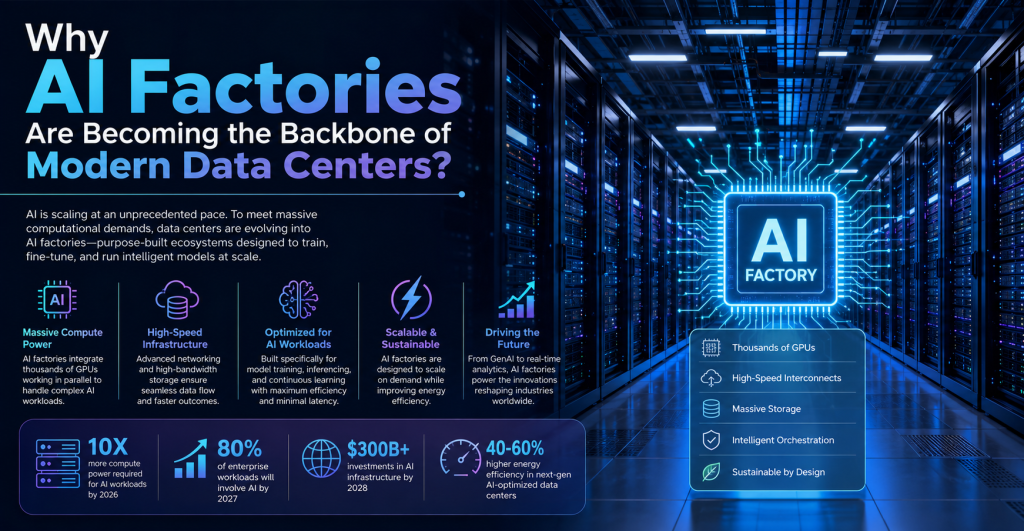

Artificial intelligence (AI) is transforming the global digital landscape at an unprecedented pace. From generative AI and autonomous vehicles to healthcare diagnostics and financial analytics, AI applications require immense computational power that traditional data centers were never designed to deliver. This growing demand has led to the emergence of AI factories, purpose-built data centers optimized specifically for AI training, inference, and large-scale data processing.
Unlike conventional facilities that primarily store and process enterprise workloads, AI factories function as intelligent production hubs where massive datasets are converted into AI models, predictions, and real-time insights. Equipped with high-performance GPUs, AI accelerators, ultra-fast networking, advanced cooling systems, and intelligent energy management, these next-generation facilities are becoming the backbone of the global AI economy.
What Are AI Factories?
An AI factory is a specialized computing infrastructure designed to maximize AI performance. Rather than focusing solely on storage and virtualization, AI factories are engineered to support resource-intensive AI workloads, including training large language models (LLMs), computer vision systems, recommendation engines, and predictive analytics.
A modern AI factory typically integrates:
- High-density GPU clusters
- AI-specific processors and accelerators
- High-speed networking (400–800 Gbps)
- Parallel storage architectures
- Liquid cooling technologies
- AI-powered workload orchestration
- Intelligent power management
These components work together to significantly reduce AI training times while improving overall computational efficiency.
Why AI Factories Are Replacing Traditional Data Centers
Traditional data centers were built for web hosting, enterprise applications, and cloud services, where CPUs handled most computing tasks. AI workloads, however, demand massive parallel processing capabilities that GPUs provide far more efficiently.
For example:
- AI server racks can consume 60–150 kW of power, compared to just 5–10 kW in traditional enterprise racks.
- Modern GPU clusters can accelerate AI model training by 20–50 times compared to CPU-only environments.
- High-speed interconnects operating at 400 Gbps or higher reduce communication delays between thousands of GPUs, improving distributed AI training efficiency by 15–30%.
As AI models continue to grow in size, conventional infrastructure struggles to keep pace, making AI factories an essential investment for technology companies and enterprises.
Market Growth and Investment Trends
Global investment in AI infrastructure is increasing rapidly as organizations expand their AI capabilities.
Some notable industry trends include:
| AI Infrastructure Indicator | Estimated Growth |
|---|---|
| Enterprise AI adoption | Nearly 75% of large organizations are expected to integrate AI into core business operations within the next few years. |
| AI infrastructure spending | Growing by more than 30% annually in several major technology markets. |
| GPU server demand | Increasing by over 40% year-over-year due to rising AI workloads. |
| AI share of hyperscale computing | Expected to account for more than 50% of advanced computing workloads before the end of the decade. |
These figures highlight the growing importance of AI factories as organizations compete to build more capable AI systems.
Key Technologies Driving AI Factories
GPU-Accelerated Computing
Graphics Processing Units (GPUs) have become the foundation of AI factories because they perform thousands of mathematical operations simultaneously. This parallel architecture dramatically improves training speed for neural networks and generative AI models.
Large AI factories often deploy thousands or even tens of thousands of GPUs working together to train increasingly complex AI models.
High-Speed Networking
Efficient communication between computing nodes is essential for distributed AI training. AI factories utilize high-bandwidth Ethernet and advanced networking technologies that minimize latency and maximize data throughput.
Faster networking enables organizations to complete AI training projects more quickly while improving hardware utilization.
Advanced Cooling Solutions
AI hardware generates significantly more heat than conventional servers. To maintain performance and reliability, many AI factories are replacing traditional air cooling with liquid cooling technologies.
Direct-to-chip liquid cooling and immersion cooling can reduce cooling energy requirements by 30–40%, while supporting much higher server densities within the same physical space.
Intelligent Energy Management
Electricity represents one of the highest operational costs for AI infrastructure. AI factories increasingly deploy intelligent energy management systems that dynamically optimize workload distribution, monitor power consumption, and integrate renewable energy sources.
Many next-generation facilities aim for a Power Usage Effectiveness (PUE) of approximately 1.2, significantly improving efficiency compared to older data centers with PUE values above 1.6.
Industry Applications
AI factories are transforming operations across multiple sectors.
Healthcare organizations use AI factories for medical imaging, genomic analysis, and drug discovery. AI-assisted research can reduce early-stage drug development timelines by 30–50% for selected processes.
In financial services, AI supports fraud detection, algorithmic trading, customer service automation, and risk analysis by processing millions of transactions within seconds.
Manufacturing companies leverage AI factories for predictive maintenance, robotics, digital twins, and automated quality inspection. Predictive maintenance alone can reduce equipment downtime by 20–40% while lowering maintenance costs by nearly 25%.
The automotive industry depends on AI factories to develop autonomous driving systems that require continuous training using petabytes of sensor data collected from vehicles worldwide.
Scientific institutions also rely on AI factories to accelerate climate modeling, molecular simulations, materials research, and high-performance scientific computing.
Sustainability Challenges
Despite their advantages, AI factories present significant environmental challenges due to their high electricity consumption and cooling requirements.
To improve sustainability, operators are increasingly adopting:
- Renewable energy integration
- AI-based energy optimization
- Waste heat recovery systems
- Modular infrastructure designs
- Water-efficient cooling technologies
These initiatives help reduce operational costs while supporting long-term environmental goals.
The Future of AI Factories
As AI models become larger and more sophisticated, AI factories will continue evolving into intelligent computing ecosystems. Future facilities are expected to incorporate photonic networking, autonomous infrastructure management, advanced AI chips, edge AI deployments, and even quantum computing integration for specialized workloads.
Industry analysts expect AI computing demand to continue growing rapidly throughout the next decade, making AI factories one of the most strategic investments in digital infrastructure.
Final Thoughts
AI factories represent the next evolution of data centers, designed specifically to meet the growing computational demands of artificial intelligence. By combining GPU-accelerated computing, ultra-fast networking, intelligent energy management, and advanced cooling technologies, these facilities deliver the performance required for modern AI applications while improving operational efficiency.
As enterprises increasingly adopt AI to drive innovation, automate processes, and enhance decision-making, AI factories will play a central role in enabling this transformation. Organizations that invest in AI-ready infrastructure today will be better positioned to compete in an economy where intelligent computing is becoming a critical driver of growth, productivity, and technological advancement.