
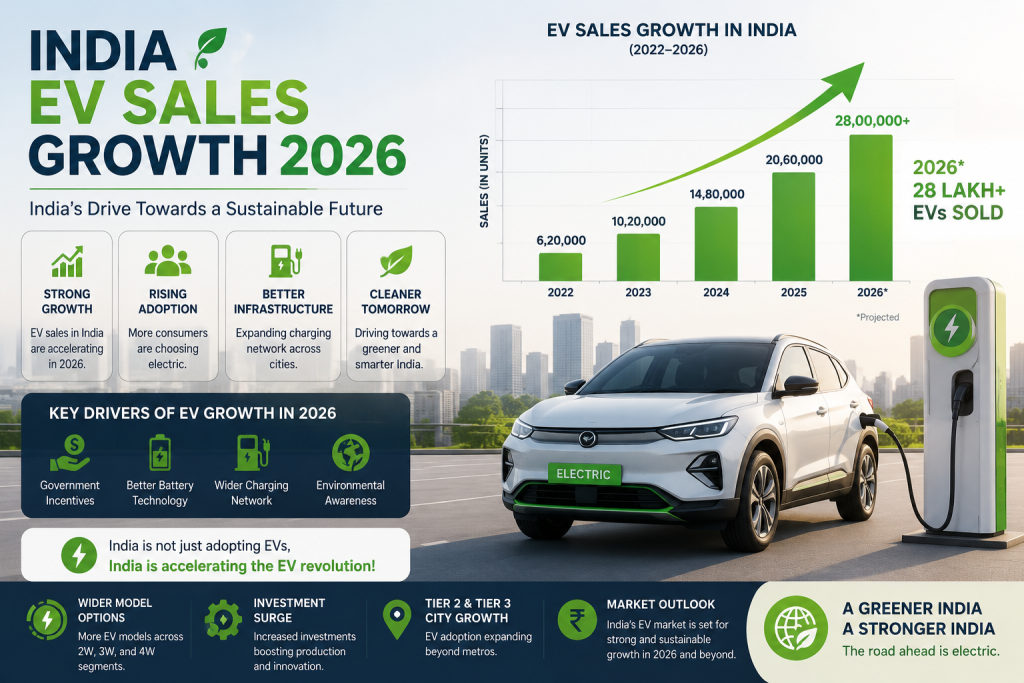

India’s electric vehicle (EV) market is witnessing one of the most significant transformations in its automotive history. In 2026, electric mobility is no longer viewed as a niche segment but as a major pillar of the country’s transportation future. Rising fuel prices, growing environmental awareness, supportive government policies, and rapid technological advancements have accelerated EV adoption across passenger vehicles, two-wheelers, three-wheelers, and commercial fleets. As manufacturers introduce affordable models and charging infrastructure continues to expand, India is steadily moving toward a cleaner and more sustainable mobility ecosystem.
The Momentum Behind India’s EV Market
The growth of electric vehicle sales in India during 2026 is the result of several factors working together. Consumers are becoming increasingly conscious of fuel expenses and vehicle maintenance costs. Electric vehicles offer lower operating costs compared to conventional petrol and diesel vehicles, making them an attractive long-term investment for both individuals and businesses.
Urbanization has also contributed to the surge in demand. As cities become more crowded, commuters are looking for efficient, cost-effective, and environmentally friendly transportation options. Electric scooters, motorcycles, and compact electric cars have become practical choices for daily travel, especially in metropolitan areas.
At the same time, Indian consumers have gained greater confidence in EV technology as battery performance, driving range, and charging convenience continue to improve.
Government Policies Accelerating Adoption
Government initiatives remain one of the strongest drivers of India’s electric mobility revolution. National and state governments have introduced incentives designed to encourage both manufacturers and consumers to adopt electric vehicles.
These measures include purchase subsidies, tax benefits, reduced registration fees, lower road taxes, and financial support for charging infrastructure development. Many states have also announced dedicated EV policies that encourage local manufacturing, battery production, and research into clean transportation technologies.
These supportive policies have helped reduce ownership costs while creating a favorable environment for long-term industry growth.
Two-Wheelers Continue Leading the Market
Electric two-wheelers remain the largest contributor to India’s EV sales in 2026. Scooters and motorcycles account for a significant share of total electric vehicle registrations due to their affordability, convenience, and suitability for city commuting.
Young professionals, students, and delivery executives increasingly prefer electric scooters because they offer lower running costs and require less maintenance than traditional fuel-powered vehicles. The growing popularity of app-based delivery services has also boosted demand for electric two-wheelers used in food delivery, courier operations, and last-mile logistics.
Manufacturers continue introducing new models with improved battery life, faster charging, and smart connectivity features, making electric two-wheelers even more attractive.
Passenger Electric Cars Gain Popularity
Although electric cars represent a smaller share of total vehicle sales than two-wheelers, the passenger EV segment is experiencing steady expansion in 2026.
Consumers now have access to a wider range of electric cars across different price categories, from compact city vehicles to premium SUVs. Improvements in battery technology have increased driving ranges, helping reduce concerns about long-distance travel.
Features such as connected infotainment systems, advanced driver assistance technologies, regenerative braking, and fast charging capabilities are making electric cars increasingly competitive with conventional vehicles.
Growing awareness about environmental sustainability is also encouraging families to consider electric vehicles as their next purchase.
Expansion of Charging Infrastructure
Charging availability has become a critical factor in supporting India’s EV sales growth. Public and private investments have accelerated the installation of charging stations across highways, shopping malls, office complexes, residential communities, and public parking areas.
Fast-charging technology continues to evolve, significantly reducing charging times and making electric vehicles more convenient for everyday use. Many businesses are also installing workplace charging facilities to support employees who drive electric vehicles.
Home charging solutions remain popular, particularly among urban households, allowing owners to conveniently recharge their vehicles overnight.
The continued expansion of charging infrastructure is helping eliminate one of the biggest barriers to EV adoption.
Commercial Fleets Embrace Electrification
Businesses are increasingly transitioning their fleets to electric vehicles in 2026. Logistics companies, ride-hailing platforms, courier services, and public transportation operators recognize the financial and environmental benefits of electrification.
Electric buses are becoming more common in several Indian cities as governments invest in cleaner public transportation systems. Meanwhile, electric three-wheelers continue to dominate last-mile passenger transport and cargo delivery in both urban and semi-urban regions.
Fleet operators benefit from lower fuel expenses, reduced maintenance requirements, and predictable operating costs, making EVs an economically attractive option.
Challenges That Still Need Attention
Despite impressive progress, India’s electric vehicle ecosystem still faces several challenges. Charging infrastructure, while expanding rapidly, remains unevenly distributed across rural and remote areas. Long-distance travel continues to require better charging coverage.
Battery manufacturing and raw material sourcing remain important priorities as India seeks to strengthen domestic supply chains and reduce dependence on imports.
Consumer concerns regarding battery replacement costs, resale value, and charging accessibility also require continued attention. Addressing these issues through innovation, policy support, and industry collaboration will further accelerate EV adoption.
Future Outlook
India’s electric vehicle market is expected to maintain strong growth beyond 2026. Advances in battery chemistry, local manufacturing, software integration, and smart charging technologies are likely to make EVs even more affordable and efficient.
Artificial intelligence, connected mobility, and vehicle-to-grid technologies may further transform how electric vehicles interact with transportation and energy systems. Increased investment in renewable energy will also strengthen the environmental benefits of electric mobility.
As more automakers expand their EV portfolios and consumers become increasingly comfortable with electric transportation, India is well-positioned to become one of the world’s leading electric vehicle markets.
Conclusion
India’s EV sales growth in 2026 reflects a remarkable shift toward sustainable transportation. Government support, technological innovation, expanding charging infrastructure, and changing consumer preferences are collectively driving this transformation. While challenges remain, the momentum behind electric mobility continues to strengthen across passenger vehicles, two-wheelers, commercial fleets, and public transport.
As the country embraces cleaner transportation solutions, electric vehicles are set to play an increasingly important role in reducing emissions, improving energy efficiency, and shaping the future of India’s automotive industry. The journey toward widespread electric mobility has only just begun, and 2026 represents a significant milestone in that transition.