
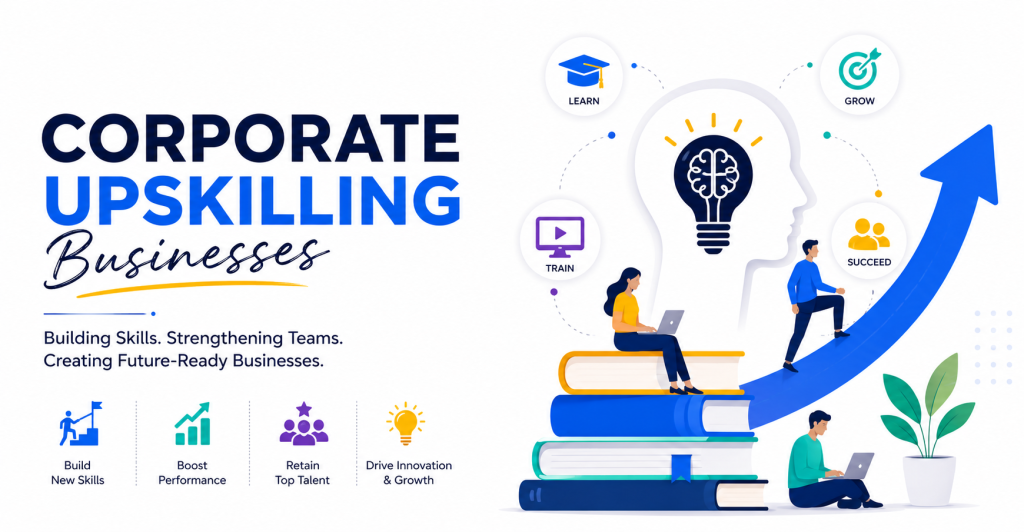

A few years ago, companies hired mostly for what people already knew. Today, that mindset is changing fast. Technology is moving so quickly that businesses can no longer depend only on outside hiring to stay competitive. They now need to help their existing teams learn new skills, adapt faster, and grow with the business.
That shift has created a powerful opportunity: corporate upskilling. It is no longer just a training trend. It is becoming a long-term business strategy for companies that want to survive and succeed in a constantly changing world.
Why Upskilling Matters Now
Workplaces have changed dramatically in a short time. Automation is handling more repetitive tasks, hybrid work has become normal, and digital tools are now part of everyday operations. On top of that, artificial intelligence is reshaping how companies operate across almost every industry.
Because of this, employees are expected to keep learning. A skill that was valuable yesterday may become outdated tomorrow. Businesses that do not help their teams upgrade their capabilities often face slower growth, weaker innovation, and higher hiring costs.
This is why many organizations are shifting from a “hire and hope” approach to a “develop and retain” approach. Instead of constantly looking for new talent, they are investing in the people they already trust.
More Than Traditional Training
Corporate upskilling is no longer limited to seminars, classroom sessions, or annual workshops. Learning has become more flexible, practical, and technology-driven.
Today, employees can learn through online modules, virtual classes, interactive exercises, mobile apps, and AI-powered platforms. These tools make learning easier to access and easier to apply in real work situations. The goal is not just to collect certificates. The goal is to build skills that improve performance immediately.
Microlearning has also become popular. Instead of asking employees to spend hours in one long session, companies now break learning into short, focused lessons. This fits better into busy schedules and helps people learn continuously without feeling overwhelmed.
A Growing Market for Businesses
The rise of corporate upskilling has opened the door to many business opportunities.
Training companies are now creating courses in high-demand areas such as AI, cybersecurity, cloud computing, sales, leadership, data analytics, and digital marketing. HR consultants are helping organizations identify skill gaps and build custom learning plans. Technology startups are building platforms that track progress, recommend lessons, and personalize learning for each employee.
There is also room for independent trainers, coaches, and content creators. Many professionals are earning by running workshops, creating learning content, and offering one-on-one mentoring for teams.
This growing ecosystem shows that corporate learning is not just a support service anymore. It is becoming a core business need.
New Business Models Emerging
As demand grows, companies are moving beyond one-time training programs and exploring new models.
One popular model is subscription-based learning. In this system, businesses pay for ongoing access to training content throughout the year. This works well because employee development is not a one-time event. Skills need continuous updating.
Another model gaining attention is Learning-as-a-Service. In this setup, companies outsource employee learning to specialists who manage the training content, delivery, and tracking. This gives organizations a more structured and scalable way to support workforce development.
Corporate coaching is also changing. Many executives and teams now prefer virtual coaching sessions instead of traditional classroom sessions. This gives them direct, personalized support that is often more effective than general training.
VR and AR are also entering the picture. In industries like healthcare, construction, manufacturing, and aviation, employees can practice real-world situations in safe virtual environments before facing them on the job.
These models are creating strong opportunities for startups, educators, software companies, and consulting firms.
Why Companies Are Investing More
For businesses, upskilling is not just about employee development. It is about saving money, improving performance, and preparing for the future.
Hiring new employees is expensive. Companies spend money on recruitment, onboarding, and training every time someone new joins. By developing current employees, businesses can reduce these costs while increasing loyalty and retention.
Upskilling also helps companies respond faster to market changes. When employees understand new tools and technologies, the organization can adapt more quickly and stay ahead of competitors. That is especially important in industries where digital transformation is happening at high speed.
There is also a cultural benefit. Employees who feel supported in their growth are more motivated, more engaged, and more likely to stay with the company. Learning creates confidence, and confident employees are often better problem solvers.
Challenges in Corporate Upskilling
Even though the opportunity is large, corporate upskilling comes with real challenges.
The first challenge is engagement. Many employees see training as an extra task unless they understand how it helps their career. Companies need to build a learning culture where development feels valuable, not forced.
Another challenge is relevance. Skills change quickly, especially in technology-driven industries. Training content that feels useful today may become outdated within months. That means companies need learning systems that can adapt fast.
Measuring results is also difficult. Businesses do not just want to know how many people completed a course. They want to know whether the training improved productivity, reduced turnover, increased revenue, or improved customer service.
The providers who can solve these problems will have a clear advantage in the market.
The Role of Artificial Intelligence
Artificial intelligence is making corporate learning smarter and more personalized.
Modern learning systems can recommend courses based on an employee’s role, current skills, and career goals. They can identify skill gaps, track progress, and suggest the next area of learning. This makes training more relevant and more effective.
Instead of giving every employee the same learning path, AI allows companies to tailor development to individual needs. That saves time and improves results. For businesses building AI-powered learning products, this is a major growth opportunity.
AI is also helping companies understand which skills matter most for future roles. That means training can become more strategic and less generic.
Why Small Businesses Should Care
Corporate upskilling is not only for large companies. Small businesses also need to build stronger teams if they want to grow.
In fact, smaller organizations may benefit even more because they often cannot afford constant hiring. Training existing staff is usually cheaper than bringing in new talent. Affordable online platforms and virtual coaching make this possible even for small teams.
Upskilling also helps small businesses stay flexible. When employees can handle multiple tasks and adapt to new tools, the business becomes more resilient. In a competitive market, that flexibility can make a major difference.
The Future of Workplace Learning
The future of corporate upskilling is closely tied to the future of work.
Skills-based hiring is likely to grow, meaning employers will focus more on what people can do rather than only on degrees or past job titles. Lifelong learning will become normal. Employees will expect their workplace to help them grow, and companies that provide that support will be more attractive to top talent.
Learning platforms will likely become more connected, combining AI, analytics, coaching, and immersive training into one experience. The result will be faster learning, better personalization, and stronger business outcomes.
For entrepreneurs, this opens the door to building products and services that help companies train smarter and faster.
Final Thoughts
Corporate upskilling is no longer just about teaching employees new things. It is about helping businesses stay competitive in a world where change never slows down.
Companies that invest in their people are building more than skills. They are building adaptability, loyalty, and long-term strength. That makes upskilling one of the smartest business opportunities of this decade.
For startups, consultants, educators, and technology providers, the market is wide open. The need is real, the demand is growing, and the future belongs to organizations that understand one simple truth: the best way to prepare for tomorrow is to keep learning today.