
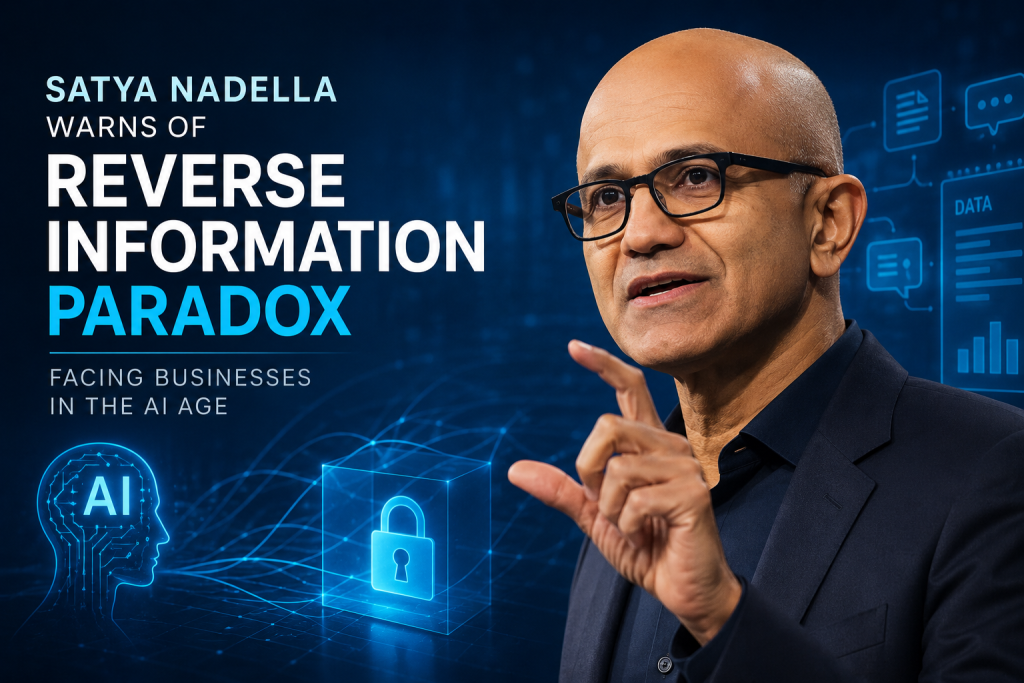

Artificial intelligence is transforming the way organizations operate, but Microsoft CEO Satya Nadella believes companies could be overlooking a significant risk. Speaking about what he calls the “Reverse Information Paradox,” Nadella warned that businesses may unknowingly give away their most valuable competitive asset—their proprietary knowledge—while using AI platforms.
As enterprises increasingly rely on AI assistants, copilots, and large language models, Nadella argues that organizations need to rethink how they manage and protect the information they feed into these systems.
Understanding the Reverse Information Paradox
Nadella’s concept builds on economist Kenneth Arrow’s Information Paradox, which states that the value of information cannot be fully assessed until it has been shared. In the AI age, Nadella believes this relationship has flipped.
Businesses now provide AI systems with internal documents, workflows, customer insights, and operational knowledge to receive better responses and automation. While this boosts productivity, it also means companies may be contributing unique intellectual property that could reduce their long-term competitive advantage if not properly governed.
Why Enterprise Data Is Becoming More Valuable Than Ever
Unlike public information available on the internet, enterprise data reflects years of experience, decision-making, customer interactions, and operational expertise.
Examples include:
- Internal policies and documentation
- Product development strategies
- Customer support knowledge bases
- Financial and operational workflows
- Industry-specific expertise
According to Nadella, this accumulated intelligence is what makes businesses unique, making it essential to safeguard while adopting AI technologies.
The Hidden Cost of AI Adoption
Most organizations view AI as a software investment, but Nadella suggests there is another cost that often goes unnoticed.
Every prompt, document upload, workflow, and feedback loop contributes valuable organizational knowledge. If companies fail to maintain visibility over how this information is stored, processed, or reused, they risk creating what Nadella describes as “AI exhaust”—valuable knowledge leaving the organization without sufficient control or ownership.
Building AI Without Losing Competitive Advantage
Nadella recommends that businesses establish strong governance around enterprise AI rather than slowing adoption.
Key priorities include:
- Maintaining ownership of organizational knowledge
- Using secure enterprise AI platforms
- Implementing clear data governance policies
- Tracking how proprietary information is shared with AI systems
- Ensuring transparency in AI workflows
These practices can help organizations benefit from AI while protecting their intellectual property and long-term business value.
Why This Matters for Every Business
Whether a company is using AI for customer support, software development, marketing, or internal operations, proprietary knowledge is becoming one of its most valuable assets.
As AI adoption accelerates across industries, organizations will need to balance innovation with responsible data management. Nadella’s warning serves as a reminder that success with AI depends not only on adopting the latest tools but also on preserving the unique expertise that differentiates a business from its competitors.
Final Thoughts
AI has enormous potential to improve productivity, automate complex tasks, and accelerate innovation. However, Satya Nadella’s “Reverse Information Paradox” highlights an emerging challenge for modern enterprises: the more businesses rely on AI, the more carefully they must manage the knowledge they share.
Organizations that combine AI adoption with strong governance, security, and ownership of their intellectual property are likely to be better positioned to unlock AI’s benefits while maintaining their competitive edge.