
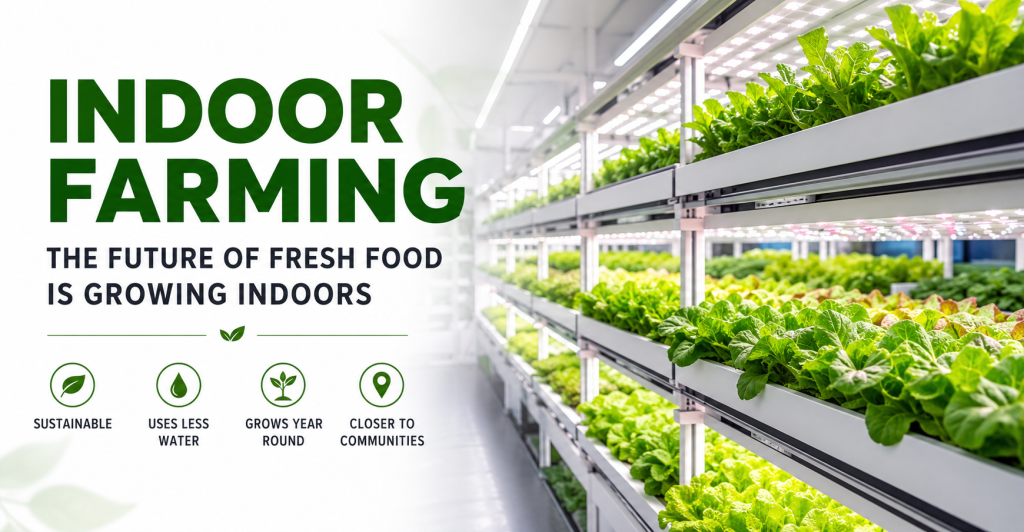

Indoor farming is transforming the way food is grown by bringing agriculture into controlled indoor environments. From leafy greens cultivated in vertical farms to strawberries grown under LED lights, this innovative farming method is helping produce fresh food year-round while using fewer natural resources.
As climate change, urbanization, and food security concerns continue to challenge traditional agriculture, indoor farming has emerged as one of the fastest-growing opportunities in the global agriculture sector. Governments, startups, and major food companies are investing heavily in this technology to create more sustainable and resilient food production systems.
What Is Indoor Farming?
Indoor farming is the practice of growing crops inside enclosed facilities such as warehouses, greenhouses, shipping containers, or purpose-built vertical farms. Instead of relying on natural sunlight and unpredictable weather, farmers use artificial lighting, climate control systems, and advanced monitoring technologies to create the ideal growing conditions.
Unlike conventional farming, indoor farming enables growers to precisely control temperature, humidity, water, nutrients, and light, resulting in consistent crop quality throughout the year.
Why Indoor Farming Is Gaining Momentum
Several global trends are accelerating the adoption of indoor farming:
- Rising demand for locally grown fresh produce
- Increasing concerns about food security
- Water scarcity in many regions
- Climate change affecting traditional agriculture
- Rapid urban population growth
- Advancements in agricultural technology and automation
Consumers also increasingly prefer pesticide-free, locally produced vegetables with shorter supply chains, making indoor farming an attractive solution.
Types of Indoor Farming
Vertical Farming
Vertical farming stacks crops in multiple layers, maximizing production within a limited footprint. It is particularly popular in urban areas where land availability is limited.
Hydroponics
Hydroponic systems grow plants in nutrient-rich water instead of soil. This technique significantly reduces water consumption while promoting faster plant growth.
Aeroponics
In aeroponic farming, plant roots are suspended in the air and regularly misted with nutrient solutions. This approach uses even less water than hydroponics and supports healthy root development.
Aquaponics
Aquaponics combines fish farming with hydroponics. Waste produced by fish supplies nutrients for plants, while plants naturally filter the water, creating a sustainable ecosystem.
Key Technologies Powering Indoor Farms
Modern indoor farms rely on several advanced technologies, including:
- LED grow lighting
- Artificial intelligence (AI)
- Internet of Things (IoT) sensors
- Automated irrigation systems
- Climate control software
- Robotics and harvesting automation
- Data analytics for crop optimization
These technologies enable growers to monitor plant health in real time and make precise adjustments that maximize productivity.
Benefits of Indoor Farming
Year-Round Food Production
Indoor farms are unaffected by seasonal weather changes, enabling continuous harvesting throughout the year.
Reduced Water Usage
Many indoor farming systems use up to 90–95% less water than conventional agriculture by recycling irrigation water.
Higher Crop Yields
Controlled growing conditions allow plants to mature faster and produce more harvests annually.
Less Land Requirement
Vertical farming enables food production in compact urban spaces, reducing the need for large agricultural fields.
Minimal Pesticide Use
Because indoor environments are protected from many pests and diseases, chemical pesticide use is significantly reduced.
Shorter Supply Chains
Growing food closer to consumers lowers transportation costs, reduces spoilage, and decreases carbon emissions.
Challenges Facing Indoor Farming
Despite its advantages, indoor farming also faces several challenges.
High Initial Investment
Building controlled-environment facilities requires substantial capital for infrastructure, lighting, automation, and climate systems.
Energy Consumption
Artificial lighting and environmental controls consume significant electricity, making energy costs one of the industry’s biggest operational challenges.
Limited Crop Variety
Indoor farming is currently most suitable for leafy greens, herbs, microgreens, and some fruits. Staple crops such as wheat, rice, and corn remain difficult to grow economically indoors.
Skilled Workforce
Operating advanced indoor farms requires expertise in agriculture, engineering, software, and data management.
Industries Driving Indoor Farming Growth
Indoor farming is expanding across multiple industries, including:
- Fresh vegetables
- Herbs and spices
- Strawberries and berries
- Medicinal plants
- Plant-based food ingredients
- Pharmaceutical crops
- Research laboratories
- Space agriculture research
As technology advances, more crop varieties are expected to become commercially viable.
Global Investment in Indoor Farming
The indoor farming ecosystem has attracted billions of dollars in investment over the past decade. Venture capital firms, agricultural technology companies, supermarket chains, and government agencies are funding innovative farming solutions.
Countries such as the United States, Japan, Singapore, the Netherlands, and the United Arab Emirates are rapidly expanding indoor farming projects to strengthen domestic food production and reduce dependence on imports.
Large retailers are also partnering with indoor farms to provide consumers with fresh, locally grown produce while reducing transportation distances.
Sustainability Impact
Indoor farming aligns closely with global sustainability goals by reducing water consumption, minimizing food waste, lowering pesticide usage, and enabling local food production.
Many facilities are also integrating renewable energy sources such as solar power and energy-efficient LED systems to reduce operational emissions.
Additionally, indoor farms can operate in urban environments, repurposing unused buildings and warehouses into productive agricultural spaces.
Future Trends in Indoor Farming
Several innovations are expected to shape the next generation of indoor agriculture:
- AI-powered crop management
- Autonomous harvesting robots
- Digital twins for farm optimization
- Renewable-powered farming facilities
- Advanced plant genetics
- Smart nutrient delivery systems
- Blockchain-enabled food traceability
- Expansion into developing economies
As production costs continue to decline and technology becomes more accessible, indoor farming is expected to become an increasingly important part of the global food system.
Final Thoughts
Indoor farming represents a major opportunity for the future of agriculture. By combining technology, sustainability, and controlled growing environments, it offers a practical solution to many of the challenges facing traditional farming.
Although high energy costs and infrastructure investments remain hurdles, ongoing technological advancements are making indoor farming more efficient and commercially viable. As demand for fresh, local, and sustainable food continues to rise, indoor farming is well positioned to play a significant role in feeding growing populations while conserving natural resources.
Whether through vertical farms in city centers or high-tech greenhouses in rural areas, indoor farming is redefining how and where food is grown—bringing agriculture closer to consumers and creating new opportunities across the global food supply chain.