
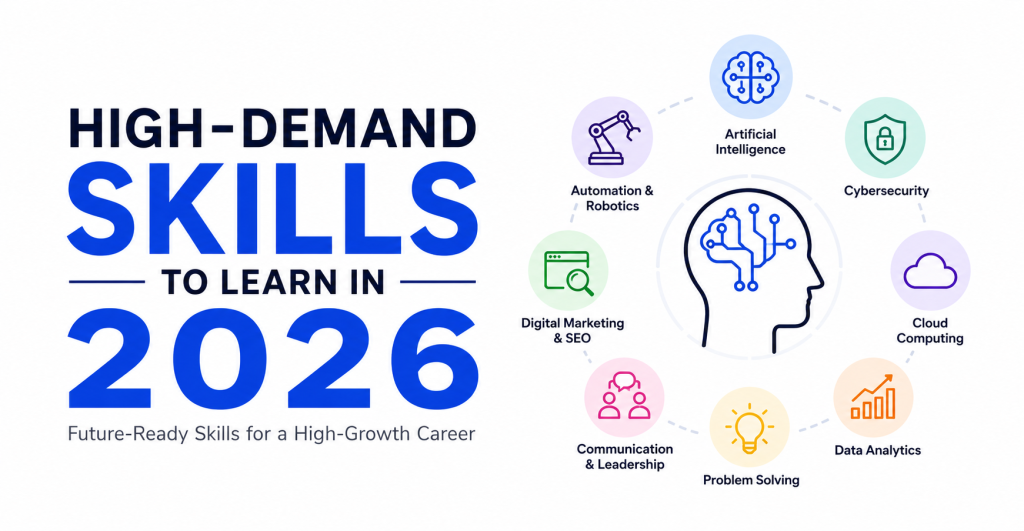

The global job market in 2026 is being reshaped by rapid technological acceleration, widespread AI integration, and a steady shift toward digital-first business models. Today, organizations are no longer evaluating talent purely on degrees or traditional experience. Instead, the focus has clearly moved toward demonstrable, adaptive, and cross-functional skills that align with automation, data-driven decision-making, and ongoing digital transformation.
This shift is not limited to the tech industry. Sectors like healthcare, finance, education, manufacturing, and even creative industries are now deeply influenced by AI tools, cloud platforms, and analytics-driven workflows. As a result, skill-building in 2026 is less about mastering a single domain and more about combining technical capability with strategic thinking and adaptability.
The 2026 Skill Landscape: Why Upskilling Is Accelerating
The rising demand for new skills is primarily driven by three major forces: automation, AI adoption, and large-scale digital transformation. Across industries, organizations are actively investing in AI-enabled systems to improve productivity and reduce operational costs. This transition is creating both disruption and opportunity.
One of the most noticeable changes is the emergence of hybrid roles. For example, marketers are now expected to understand data analytics, while developers are increasingly required to integrate AI models into applications. Even non-technical roles are now expected to have a basic level of digital literacy and familiarity with automation tools.
Another important factor is the speed at which technology is evolving. Skills that were considered advanced just a few years ago—such as basic machine learning or cloud deployment—are now becoming foundational. Continuous learning is no longer optional; it has become a core part of career growth.
Today, in-demand skills generally fall into these categories:
- Transferable across industries
- Aligned with AI and automation
- Based on data interpretation and decision-making
- Adaptable to evolving digital ecosystems
Artificial Intelligence and Machine Learning Skills Dominating the Market
AI continues to dominate the list of high-demand skills in 2026, as it is now embedded across customer service, software development, logistics, finance, and content creation. The rise of generative AI has further expanded what individuals and businesses can achieve with relatively low technical barriers.
Generative AI and Applied AI Systems
Generative AI is no longer experimental—it is now part of everyday enterprise workflows. Companies are actively seeking professionals who can build, fine-tune, and deploy AI models for practical applications. This includes areas like prompt engineering, model evaluation, and AI-assisted product design.
The demand is shifting away from pure AI researchers toward applied AI professionals who can convert models into scalable business solutions. This often includes API integration, automation pipelines, and real-time optimization.
Machine Learning Engineering and MLOps
Machine learning engineering in 2026 is highly production-focused. The emphasis is less on prototyping and more on deploying reliable, scalable, and maintainable systems. MLOps (Machine Learning Operations) has become especially important in bridging development and deployment.
Key responsibilities now include model monitoring, retraining pipelines, and performance optimization. Alongside this, ethical AI practices are also gaining importance in enterprise environments.
Data Skills and Analytics as a Core Business Driver
Data continues to be the foundation of digital transformation. As organizations generate massive volumes of structured and unstructured data, the real value lies in how effectively this data is interpreted and used for decision-making.
Data Engineering and Infrastructure
Data engineering has become a critical function in modern organizations. Professionals in this space are responsible for building robust pipelines that support both real-time and batch data processing. Skills in distributed systems, data lakes, and scalable architectures are in high demand.
Today, data engineers play a central role in enabling AI systems by ensuring clean, structured, and accessible datasets.
Data Analytics and Storytelling
Beyond technical expertise, there is now a strong emphasis on communication. Data storytelling has emerged as a key skill that combines analytics with business understanding. The ability to translate data into actionable insights is what distinguishes high-performing analysts.
Core areas include:
- Data visualization and dashboards
- Business intelligence reporting
- Predictive analytics and forecasting
- KPI tracking and performance measurement
Cloud Computing, Cybersecurity, and Digital Infrastructure
As organizations continue shifting to cloud-first architectures, cloud computing and cybersecurity remain foundational pillars of modern IT systems. These areas are evolving rapidly and are essential in the list of high-demand skills in 2026.
Cloud Architecture and Multi-Cloud Systems
Cloud platforms like AWS, Azure, and Google Cloud are now standard in enterprises. However, the demand has shifted from basic usage to advanced architecture design. Professionals who can build scalable, cost-efficient, and resilient cloud systems are in high demand.
Multi-cloud strategies are also becoming common, requiring expertise in interoperability and cross-platform management.
Cybersecurity and Zero Trust Models
With rising digital threats, cybersecurity has become a top priority across industries. Organizations are increasingly adopting zero-trust models, where no user or system is automatically trusted.
Key areas of focus include:
- Threat detection and response
- Identity and access management
- Data encryption and protection
- Cloud security frameworks
- Incident response planning
DevSecOps is also becoming widely adopted, integrating security directly into development pipelines.
Product, Marketing, and SEO Evolution in an AI-First World
Digital marketing and product strategy have significantly evolved due to AI-powered search, personalization, and automation. This has reshaped the skills required in marketing and growth roles.
SEO, AEO, and Search Evolution
Traditional SEO is now evolving into a broader ecosystem that includes Answer Engine Optimization (AEO) and AI-driven search optimization. Search engines are increasingly delivering direct answers instead of just links.
This shift requires a deeper understanding of semantic search, entity-based optimization, and intent-driven content. Technical SEO remains essential, especially in areas like site structure, Core Web Vitals, and structured data.
Performance Marketing and Automation
Marketing automation is now heavily AI-driven, enabling real-time optimization of campaigns. Professionals are expected to understand segmentation, predictive targeting, and attribution modeling.
The field now demands a balance of creativity and analytical thinking, where data plays a central role in decision-making.
Human-Centric Skills That Remain Irreplaceable
Despite increasing automation, human skills continue to play a critical role. In fact, they are becoming even more valuable when combined with technical expertise.
Critical Thinking and Decision-Making
With AI generating vast amounts of information, the ability to evaluate relevance and accuracy is essential. Decision-making now requires context, ethics, and long-term thinking.
Communication and Leadership
As workplaces become more distributed and cross-functional, communication skills are a major differentiator. Effective leaders are those who can clearly articulate vision and align teams across functions.
Creativity and Problem-Solving
While automation handles repetitive tasks, creative thinking remains uniquely human. Innovation, product design, and complex problem-solving continue to depend heavily on human insight.
Key human skills include:
- Emotional intelligence and empathy
- Strategic thinking
- Cross-team collaboration
- Adaptability in changing environments
Emerging Skills: Blockchain, Robotics, and Spatial Computing
Several emerging technologies are shaping the next phase of innovation. While still developing, they are increasingly relevant in forward-looking skill discussions.
Blockchain and Decentralized Systems
Blockchain is expanding beyond cryptocurrencies into areas like supply chain, identity management, and secure data sharing. Skills in smart contracts and decentralized applications are gaining traction.
Robotics and Automation Systems
Robotics is transforming manufacturing, logistics, and healthcare. Skills in robotics programming, sensors, and automation design are becoming more relevant as industries move toward intelligent systems.
Spatial Computing and Extended Reality
Spatial computing, including AR and VR, is gaining momentum in training, retail, gaming, and remote collaboration. Designing immersive digital environments is becoming a niche but growing skill area.
How Professionals Should Approach Skill Development in 2026
With so many evolving domains, the key is not to learn everything, but to learn strategically.
A practical approach looks like this:
- Build strong foundations in digital literacy and data understanding
- Choose one deep specialization (AI, cybersecurity, data engineering, etc.)
- Develop complementary soft skills like communication and problem-solving
- Focus on real-world projects for practical experience
- Stay updated with industry trends to anticipate changes early
Final Thought
Skill development in 2026 is fundamentally about adaptability. Professionals who succeed will be those who can combine technical depth with strategic awareness and a consistent learning mindset.