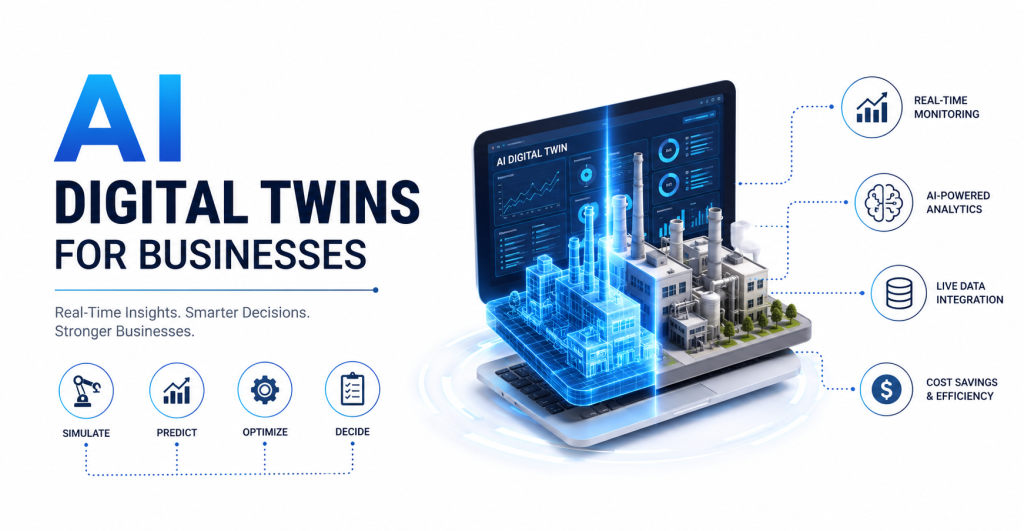

Artificial Intelligence is no longer limited to chatbots, automation, or content generation. A new technology is rapidly emerging that has the potential to reshape how companies design products, manage factories, reduce costs, and make business decisions. That technology is AI Digital Twins.
Over the next decade, AI Digital Twins are expected to become one of the most valuable technologies across manufacturing, healthcare, retail, logistics, construction, and even smart cities. While the concept has existed for years, recent advances in artificial intelligence, cloud computing, sensors, and real-time data processing have made digital twins far more intelligent and commercially viable.
What Is an AI Digital Twin?
A digital twin is a virtual replica of a real-world object, machine, process, or even an entire business operation. Unlike a simple simulation, an AI-powered digital twin continuously receives live data from sensors, software systems, and connected devices.
Artificial intelligence then analyzes that data, predicts future outcomes, identifies potential problems, and recommends the best actions before issues occur.
Imagine having a virtual version of your factory, warehouse, supply chain, or production line that operates alongside the real one. You can test changes, predict failures, improve efficiency, and reduce costs without interrupting actual operations.
This is exactly what AI Digital Twins make possible.
Why Businesses Are Paying Attention
Companies today face rising operational costs, supply chain disruptions, labor shortages, and increasing customer expectations. Traditional management systems often react only after a problem appears.
AI Digital Twins change this approach by helping businesses predict future scenarios instead of simply responding to them.
For example, a manufacturing company can detect equipment failure weeks before it happens. A logistics company can simulate different delivery routes to minimize fuel consumption. A retailer can forecast inventory demand more accurately and avoid stock shortages.
Instead of making decisions based on assumptions, businesses can rely on real-time insights supported by artificial intelligence.
Industries That Will Benefit the Most
Manufacturing
Manufacturing is expected to remain the largest adopter of AI Digital Twins.
Factories can create virtual copies of machines and production lines to monitor equipment performance continuously. Predictive maintenance helps reduce downtime, improve productivity, and extend machinery life.
Engineers can also test new production methods digitally before implementing them in the real factory.
Healthcare
Hospitals are beginning to use digital twins for medical equipment, hospital operations, and even patient-specific treatment planning.
In the future, doctors may use digital twins to simulate treatment options before performing complex medical procedures, improving accuracy while reducing risks.
Logistics and Supply Chain
Global supply chains have become increasingly complex.
AI Digital Twins allow logistics companies to model warehouses, shipping routes, inventory systems, and transportation networks. Businesses can identify bottlenecks, optimize delivery schedules, and improve inventory management while lowering operating costs.
Construction and Real Estate
Construction firms can create digital twins of buildings before construction begins.
Project managers can detect design flaws, estimate maintenance requirements, monitor structural health, and reduce expensive errors during construction.
Smart buildings can continue using digital twins even after completion to improve energy efficiency and maintenance planning.
Retail
Retailers can simulate customer demand, optimize inventory, improve store layouts, and forecast purchasing behavior using AI-powered digital twins.
This leads to better customer experiences while reducing excess inventory and operational expenses.
Business Opportunities in the AI Digital Twin Market
The rapid adoption of AI Digital Twins is creating new opportunities for entrepreneurs, startups, software developers, and investors.
Some promising business opportunities include:
- AI Digital Twin software platforms
- Industrial IoT sensor integration services
- Predictive maintenance solutions
- Smart factory consulting
- Digital Twin cybersecurity
- Cloud infrastructure for real-time simulations
- AI analytics platforms
- Healthcare Digital Twin applications
- Smart city infrastructure management
- Energy optimization software
As more businesses adopt Industry 4.0 technologies, demand for specialized Digital Twin solutions is expected to grow significantly.
Benefits for Companies
Businesses investing in AI Digital Twins can achieve several measurable advantages.
Lower Operating Costs
Predictive maintenance reduces unexpected equipment failures and minimizes expensive downtime.
Better Decision-Making
Executives can test different business strategies virtually before implementing them in the real world.
Improved Product Development
Manufacturers can design, test, and improve products digitally, reducing development time and lowering research costs.
Higher Productivity
AI continuously monitors operations and identifies inefficiencies that human teams may overlook.
Risk Reduction
Potential operational problems can be detected before they become major disruptions.
Challenges That Still Exist
Although the future looks promising, implementing AI Digital Twins is not without challenges. Many companies still rely on outdated infrastructure that cannot easily support real-time data integration. High implementation costs, cybersecurity risks, data privacy concerns, and the shortage of skilled AI professionals remain significant obstacles. Building an accurate digital twin also requires high-quality data. Poor or incomplete data can lead to inaccurate predictions and ineffective business decisions. Despite these challenges, technology costs continue to decline, making Digital Twins more accessible for medium-sized businesses as well.
Why Investors Are Watching This Market
The AI Digital Twin industry combines several fast-growing technologies, including Artificial Intelligence, Cloud Computing, Industrial Internet of Things (IIoT), Big Data, Edge Computing, and Automation. Instead of depending on a single trend, Digital Twins benefit from multiple technological advancements happening simultaneously.
This creates long-term growth potential across many industries rather than a single market segment. As businesses continue their digital transformation journeys, spending on intelligent operational software is expected to rise throughout the next decade.
The Future Outlook
By 2035, AI Digital Twins could become a standard business tool rather than an emerging innovation.
Factories may operate with fully autonomous monitoring systems. Cities could manage transportation, utilities, and infrastructure using large-scale digital twins. Healthcare providers may personalize treatments through patient-specific virtual models. Logistics companies may optimize global shipping networks in real time. The technology will likely move beyond large corporations and become increasingly available to small and medium-sized businesses through cloud-based subscription platforms.
Final Thoughts
AI Digital Twins represent one of the most practical applications of artificial intelligence in the business world. Instead of replacing people, they help organizations make smarter decisions, reduce operational risks, improve efficiency, and accelerate innovation.
For entrepreneurs, investors, and business leaders, this technology offers an opportunity to participate in one of the fastest-evolving digital markets of the next decade.
Companies that begin exploring AI Digital Twins today may be better prepared to compete in an increasingly data-driven global economy. As industries continue embracing automation and intelligent decision-making, Digital Twins are likely to become an essential part of modern business strategy rather than just another technology trend.