
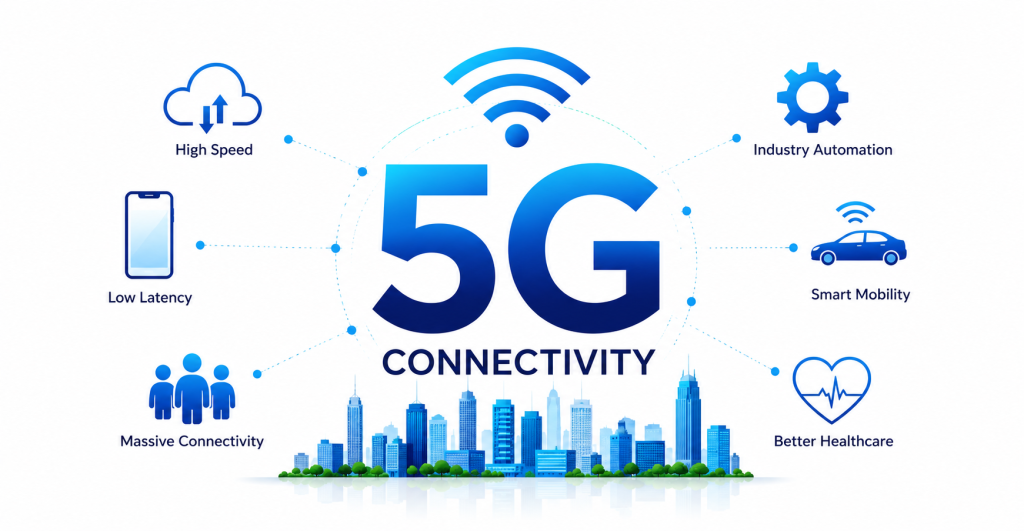

The global rollout of 5G connectivity is reshaping the digital economy, enabling faster communication, smarter automation, and new business models across industries. With ultra-low latency, high-speed data transfer, and the ability to connect millions of devices simultaneously, 5G has moved beyond being a mobile network upgrade. It has become a foundational technology for next-generation innovation.
Governments, telecom operators, technology providers, and enterprises continue investing heavily in 5G infrastructure to meet the growing demand for reliable, high-capacity networks. As coverage expands, businesses are discovering new opportunities that improve productivity, enhance customer experiences, and accelerate digital transformation.
Why 5G Matters
Unlike previous wireless generations, 5G is designed to support a wide range of applications beyond smartphones. It enables near real-time communication, making it suitable for industries that require rapid data exchange and minimal delays.
Key capabilities of 5G include:
- Download speeds significantly faster than 4G networks
- Ultra-low latency for time-sensitive applications
- Higher network reliability
- Massive connectivity for Internet of Things (IoT) devices
- Improved energy efficiency in connected systems
These capabilities are opening doors to innovations that were previously difficult to implement on a large scale.
Opportunities Across Major Industries
Manufacturing
Manufacturers are using 5G-powered private networks to support smart factories. Connected robots, automated guided vehicles, industrial sensors, and AI-driven quality inspection systems rely on fast and reliable communication.
Real-time monitoring helps reduce equipment downtime, optimize production schedules, and improve worker safety. As manufacturers continue embracing Industry 4.0 initiatives, 5G is becoming a critical technology for factory modernization.
Healthcare
Healthcare organizations are increasingly adopting connected medical devices, remote patient monitoring, and telemedicine services. High-speed connectivity enables doctors to access medical records quickly while supporting high-quality video consultations.
Hospitals are also exploring AI-assisted diagnostics, wearable health technologies, and connected emergency response systems that benefit from reliable wireless communication.
Transportation and Logistics
5G is transforming logistics by improving fleet management, warehouse automation, and shipment tracking. Connected vehicles can exchange information in real time, helping companies optimize routes, reduce fuel consumption, and improve delivery efficiency.
Ports, airports, and distribution centers are also implementing autonomous equipment and intelligent inventory management systems supported by high-speed networks.
Smart Cities
Cities worldwide are integrating intelligent traffic systems, connected street lighting, public safety solutions, and environmental monitoring platforms. These systems generate massive amounts of data that require fast processing and communication.
5G allows city administrators to respond more effectively to traffic congestion, energy consumption, and emergency situations while improving the quality of public services.
Agriculture
Modern farming increasingly depends on connected technologies. Farmers are using drones, smart irrigation systems, soil sensors, and automated machinery to improve crop productivity.
With 5G, agricultural equipment can transmit data instantly, allowing farmers to make informed decisions regarding irrigation, fertilization, and pest management.
Rising Demand for Private 5G Networks
One of the fastest-growing opportunities lies in private 5G networks. Unlike public mobile networks, private networks are built specifically for individual enterprises, providing greater security, reliability, and operational control.
Industries such as manufacturing, mining, energy, healthcare, and logistics are investing in private 5G infrastructure to support mission-critical operations. These dedicated networks reduce interference while ensuring consistent performance for connected devices and industrial applications.
AI and Edge Computing Drive Further Growth
Artificial intelligence and edge computing are expanding the value of 5G connectivity. Instead of sending all information to centralized cloud servers, edge computing processes data closer to where it is generated.
This significantly reduces response times for applications such as:
- Autonomous vehicles
- Industrial automation
- Smart surveillance
- Augmented reality
- Virtual reality
- Intelligent robotics
AI algorithms can instantly analyze data generated by connected devices, enabling faster decision-making and improved operational efficiency.
Expanding Consumer Applications
Consumers are also benefiting from broader 5G deployment. High-definition video streaming, cloud gaming, immersive virtual experiences, and smart home technologies continue gaining popularity.
The growing adoption of connected wearables, smart appliances, and home automation systems is creating new opportunities for technology companies, application developers, and service providers.
As more devices become connected, the demand for secure, high-speed wireless networks is expected to increase further.
Challenges Remain
Despite significant progress, several challenges continue to influence 5G adoption.
Infrastructure deployment requires substantial investment, particularly in rural and remote areas. Spectrum allocation, regulatory approvals, cybersecurity concerns, and interoperability between different network technologies remain ongoing priorities for governments and telecom providers.
Businesses also face the challenge of integrating legacy systems with advanced wireless infrastructure while ensuring data privacy and network security.
Addressing these issues will be essential for maximizing the long-term benefits of 5G technology.
Emerging Business Opportunities
The continued expansion of 5G is creating opportunities for companies across the technology ecosystem.
Some of the fastest-growing areas include:
- Telecom infrastructure equipment
- Semiconductor manufacturing
- Cloud computing services
- Cybersecurity solutions
- IoT platforms
- Network software development
- Edge computing services
- AI-powered industrial automation
- Smart mobility solutions
- Connected healthcare technologies
Startups are also entering the market with innovative applications tailored to specific industries, accelerating the pace of digital transformation worldwide.
Looking Ahead
As countries continue expanding nationwide coverage and enterprises accelerate digital transformation, 5G connectivity is expected to become one of the most influential technologies of the coming decade. Its ability to connect people, devices, machines, and infrastructure in real time is driving innovation across manufacturing, healthcare, transportation, agriculture, retail, and public services.
The next phase of growth will likely be defined by the convergence of 5G with artificial intelligence, cloud computing, edge computing, and the Internet of Things. Organizations that invest early in these technologies will be better positioned to improve operational efficiency, develop new digital services, and create competitive advantages in an increasingly connected economy.
Rather than serving as just another wireless standard, 5G is rapidly becoming the digital backbone that supports future smart industries, intelligent cities, and connected societies, making it one of the most significant technology opportunities shaping the global economy today.