
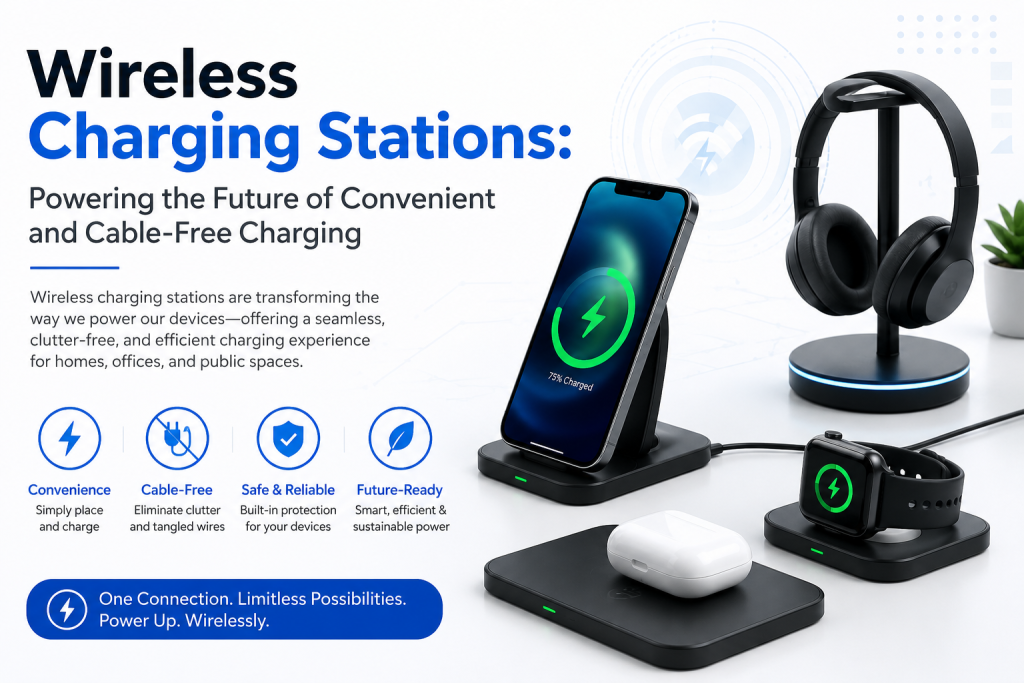

Wireless charging stations are rapidly transforming how consumers and businesses power electronic devices. As smartphones, smartwatches, earbuds, electric vehicles (EVs), and industrial equipment become more advanced, the demand for seamless, cable-free charging solutions continues to rise. By eliminating the need for physical connectors, wireless charging stations improve convenience, reduce wear and tear on charging ports, and support a cleaner, more organized user experience.
Today, around 80–90% of premium smartphones launched globally support wireless charging, making the technology a standard feature in flagship devices. Advancements in wireless power transfer technologies, including inductive charging, resonant charging, and radio frequency (RF)-based charging, are expanding the capabilities of these systems. Modern Qi2 wireless charging delivers up to 15W, while proprietary solutions from leading smartphone manufacturers now offer 50W–80W wireless fast charging, significantly reducing charging times. With increasing investments from technology companies, automotive manufacturers, and infrastructure providers, wireless charging stations are becoming an integral part of smart homes, workplaces, public spaces, and transportation networks.
Growing Adoption Across Consumer Electronics
The widespread adoption of wireless charging has been driven largely by the consumer electronics industry. Premium smartphones, wireless earbuds, smartwatches, and fitness trackers increasingly support standardized wireless charging technologies, allowing users to charge multiple devices using a single charging pad or docking station.
Manufacturers are introducing multi-device charging stations capable of powering smartphones, watches, and earbuds simultaneously. These products are particularly attractive to consumers seeking clutter-free workspaces and bedside setups. In fact, more than 65% of smartphone users charge their devices overnight, making bedside wireless charging stations one of the fastest-growing product categories.
Wireless charging technology is also finding applications in tablets, laptops, gaming accessories, and wearable medical devices. Wireless earbuds account for over 70% of global Bluetooth earbud shipments, further increasing demand for compact multi-device charging stations. As battery capacities improve and charging efficiencies increase, consumers are becoming more comfortable replacing traditional wired charging with wireless alternatives.
Electric Vehicles Create New Growth Opportunities
The electric vehicle revolution is opening significant opportunities for wireless charging station providers. While most EVs currently rely on plug-in charging, automotive companies are investing heavily in wireless charging systems that enable vehicles to recharge simply by parking over a charging pad.
The global EV fleet surpassed 58 million vehicles in 2025, while annual EV sales increased by approximately 25% year-over-year, creating strong demand for innovative charging infrastructure. Dynamic wireless charging, where vehicles receive power while moving over specially equipped roads, is also gaining research attention. Under controlled testing environments, these systems have demonstrated charging efficiencies of 85–90%, highlighting their long-term commercial potential.
Commercial fleets, autonomous taxis, buses, warehouse vehicles, and delivery robots stand to benefit significantly from automated wireless charging. These applications reduce manual intervention, minimize downtime, and improve operational efficiency. Governments supporting EV infrastructure expansion are also encouraging innovation in charging technologies, creating favorable conditions for wireless charging deployment.
Smart Homes and IoT Devices Drive Innovation
The rapid growth of smart homes is accelerating demand for wireless charging solutions. Modern households increasingly use connected devices such as smart speakers, security cameras, smart locks, wireless sensors, and home automation hubs.
The smart home ecosystem continues to expand, with connected device installations growing at an estimated 10–15% annually, increasing the need for integrated charging solutions. Wireless charging stations simplify device management by eliminating cable clutter while ensuring connected products remain powered throughout the day.
Furniture manufacturers are also integrating wireless charging pads into office desks, kitchen counters, hotel furniture, bedside tables, airport seating, and coffee shop tables. These built-in charging solutions enhance user convenience while supporting smart living environments.
As Internet of Things (IoT) deployments continue expanding, low-power wireless charging technologies may eventually provide continuous energy delivery to sensors without requiring frequent battery replacements.
Faster Charging Technologies Enhance User Experience
One of the biggest challenges facing wireless charging has traditionally been charging speed. However, recent innovations have significantly narrowed the gap between wired and wireless charging performance.
Improved coil designs, advanced thermal management systems, intelligent power control software, and higher power transfer capabilities enable faster and more efficient charging. Today, wireless charging efficiency ranges between 70% and 90%, depending on charger quality, alignment, and the charging standard being used.
Artificial intelligence is also being integrated into charging systems to optimize energy delivery based on battery health, device temperature, and user charging habits. AI-powered battery management can improve battery lifespan by approximately 15–30% through optimized charging cycles. Additionally, many advanced charging stations automatically stop charging once batteries reach 100% capacity, helping reduce unnecessary power consumption and battery degradation.
Manufacturers continue working toward universal compatibility standards, ensuring users can charge multiple devices regardless of brand or operating system.
Commercial Applications Continue Expanding
Businesses across multiple industries are adopting wireless charging stations to improve customer experience and workplace productivity.
Hotels provide wireless charging in guest rooms and conference facilities. Restaurants and cafés install charging-enabled tables that encourage customers to remain longer. Airports and transportation hubs increasingly offer public wireless charging areas for travelers. In fact, public wireless charging installations have increased by more than 30% over the past three years, reflecting growing demand for convenient charging infrastructure.
Healthcare facilities use wireless charging to power portable medical equipment while minimizing cable-related contamination risks. Retail stores incorporate wireless charging into interactive product displays and customer waiting areas.
Corporate offices also deploy wireless charging throughout meeting rooms, shared workspaces, and employee lounges, supporting flexible and hybrid work environments. Businesses offering wireless charging have reported 10–20% longer customer dwell times, particularly in cafés, retail outlets, and hospitality venues, creating additional commercial value beyond device charging.
Sustainability Benefits Support Market Expansion
Wireless charging stations contribute to sustainability efforts by reducing dependence on disposable charging accessories and damaged charging cables.
Traditional charging cables frequently require replacement because of connector damage, frayed wiring, or compatibility changes. Wireless charging minimizes physical connector wear, potentially extending device lifespan and reducing electronic waste. Surveys also indicate that over 60% of consumers prefer clutter-free charging solutions over managing multiple charging cables for different devices.
Many manufacturers are adopting recyclable materials, energy-efficient power management systems, and environmentally friendly packaging for wireless charging products.
Renewable energy integration represents another promising development. Solar-powered wireless charging stations are emerging in parks, campuses, and public spaces, providing sustainable charging options for mobile devices and electric mobility solutions.
Challenges Remain Despite Strong Momentum
Despite growing adoption, wireless charging technology still faces several challenges.
Charging efficiency remains slightly lower than traditional wired charging in many applications. Heat generation during charging requires effective thermal management to maintain performance and battery safety.
Cost also remains a consideration, particularly for high-power wireless charging systems used in electric vehicles and industrial applications. Interoperability between different manufacturers and charging standards continues to improve, but complete universal compatibility has not yet been achieved across every product category.
Infrastructure deployment, especially for public wireless EV charging, requires significant investment and standardization before achieving widespread commercialization.
Final Thoughts
The future of wireless charging stations looks highly promising as technology advances and consumer expectations evolve. Increasing adoption of smart devices, electric vehicles, autonomous systems, and connected infrastructure will continue driving market growth.
Emerging technologies such as long-distance wireless power transmission, AI-enabled energy management, and dynamic wireless vehicle charging may fundamentally reshape how electricity is delivered over the coming decade. Integrated wireless charging furniture is also expected to witness double-digit annual growth, supported by rising adoption of smart homes and modern office environments.
As industries prioritize convenience, automation, and sustainability, wireless charging stations will become an essential component of modern digital ecosystems. Continuous research, expanding infrastructure investments, and improved charging standards are expected to accelerate adoption across residential, commercial, healthcare, transportation, and industrial sectors.
With innovation occurring at an unprecedented pace, wireless charging is steadily moving beyond a premium convenience feature to become a mainstream charging solution. As efficiency improves and costs decline, cable-free power delivery is likely to become a standard expectation for consumers and businesses worldwide, supporting a smarter, more connected, and increasingly sustainable future.