
Every time you click “Buy Now,” a fascinating chain of events begins. Within seconds, your order is received by a warehouse, inventory is checked, the fastest delivery route is calculated, and a package begins its journey to your doorstep. For years, this entire process relied heavily on human coordination. Warehouse workers located products, managers planned shipments, and drivers navigated traffic to ensure deliveries arrived on time.
Today, that familiar process is undergoing one of the biggest transformations in modern business.
Artificial intelligence, robotics, autonomous vehicles, and connected technologies are gradually taking over repetitive tasks, making supply chains faster, smarter, and more efficient. What was once considered futuristic technology is now becoming a practical business solution for companies around the world.
This transformation is known as autonomous logistics, and it represents much more than automation. It is creating new business opportunities, reshaping global supply chains, and changing the way companies think about transportation, warehousing, and customer service.
For entrepreneurs, technology providers, investors, and logistics companies, the future isn’t just about moving products faster it’s about building intelligent supply chains capable of making decisions on their own.
A New Chapter for the Logistics Industry
The logistics industry has always been the engine behind global commerce, but today’s business environment is placing it under unprecedented pressure. Customers now expect deliveries within hours instead of days. Online shopping continues to grow, while businesses face rising fuel costs, labor shortages, and increasing operational expenses.
Adding more warehouses or hiring additional drivers is no longer enough to keep pace with these demands.
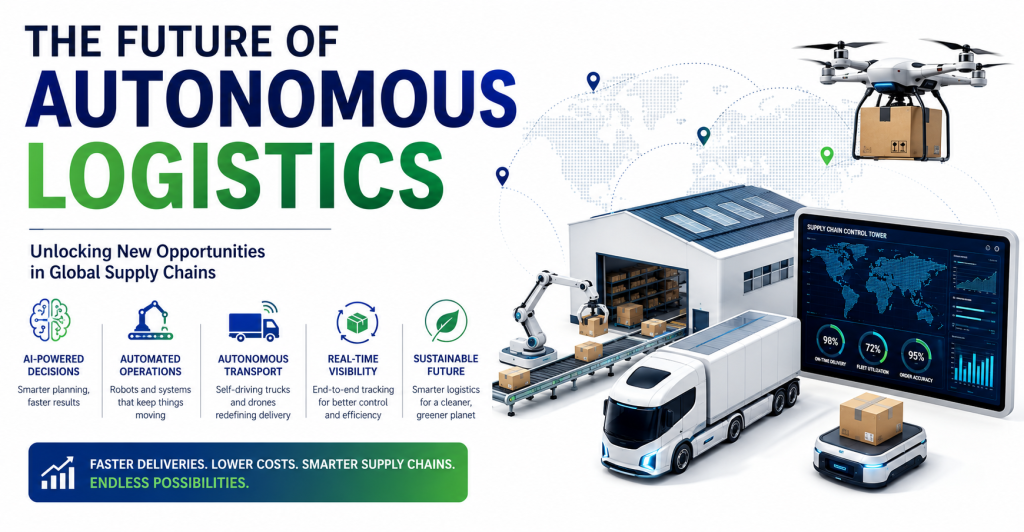
Instead, companies are searching for smarter ways to operate. They need systems that can predict demand, reduce delays, optimize routes, and manage inventory with greater accuracy. Autonomous logistics offers exactly that by combining artificial intelligence, robotics, machine learning, and real-time data into one connected ecosystem.
Rather than reacting to problems after they occur, businesses can anticipate challenges before they affect customers. This shift from reactive operations to predictive decision-making is becoming one of the industry’s biggest competitive advantages.
From Manual Operations to Intelligent Decisions
For decades, logistics depended on experience and manual planning. Managers analyzed shipment schedules, warehouse teams tracked inventory, and drivers relied on fixed routes to complete deliveries.
Today, technology is making those processes far more intelligent.
Artificial intelligence can analyze millions of data points in real time, identifying the fastest delivery routes, predicting customer demand, and forecasting inventory requirements with remarkable accuracy. Warehouse robots move products efficiently through fulfillment centers, while connected sensors monitor stock levels and equipment performance around the clock.
Instead of replacing people entirely, these technologies remove repetitive work and allow employees to focus on higher-value responsibilities such as strategic planning, customer relationships, and operational improvement.
The result is not just automation—it is a smarter way of doing business.
The Opportunity Behind the Innovation
While autonomous logistics is often discussed as a technological advancement, its greatest impact may actually be economic.
Every improvement in supply chain efficiency creates opportunities for businesses across multiple industries. Companies that can deliver products faster while reducing operational costs gain a significant competitive advantage. That advantage translates into stronger customer loyalty, improved profitability, and greater scalability.
This growing demand is opening doors for startups, software developers, robotics manufacturers, cloud service providers, cybersecurity firms, and consulting companies. Businesses are investing in AI-powered warehouse management systems, predictive analytics platforms, autonomous delivery solutions, and intelligent fleet management software.
In other words, autonomous logistics is no longer a niche market. It has become an ecosystem where innovation creates opportunities for companies of every size.
E-Commerce Is Accelerating the Shift
Perhaps no industry stands to benefit more than e-commerce.
Consumers have become accustomed to fast deliveries, accurate tracking, and seamless shopping experiences. Meeting those expectations consistently requires more than additional manpower it requires intelligent automation.
Imagine a warehouse capable of processing thousands of orders every hour without delays. Products are located instantly, robots transport inventory, and artificial intelligence continuously adjusts delivery schedules based on traffic, weather, and customer demand.
For customers, the experience feels effortless.
For businesses, it means lower operating costs, improved accuracy, and faster deliveries without dramatically increasing workforce requirements.
As online shopping continues expanding worldwide, autonomous logistics is becoming an essential part of modern retail rather than a future possibility.
Small Businesses Can Benefit Too
One of the biggest misconceptions is that autonomous logistics is only for global corporations with billion-dollar budgets.
The reality is quite different.
Cloud-based software, AI-powered inventory tools, warehouse automation platforms, and digital supply chain solutions have become increasingly affordable. Even small and medium-sized businesses can now access technologies that were once reserved for multinational companies.
This creates an exciting opportunity for entrepreneurs.
Instead of investing heavily in infrastructure, growing businesses can adopt smart logistics solutions that improve efficiency while keeping operational costs under control. Automation allows smaller companies to compete with larger organizations by delivering better customer experiences without significantly increasing overhead.
Technology is gradually becoming the great equalizer in modern logistics.
Sustainability Is Becoming Part of the Business Strategy
The future of logistics isn’t only about speed.
It’s also about responsibility.
Businesses are under increasing pressure to reduce emissions, minimize waste, and operate more sustainably. Autonomous logistics supports these goals in practical ways.
Artificial intelligence identifies shorter delivery routes that reduce fuel consumption. Electric autonomous vehicles lower carbon emissions, while smart warehouses optimize energy usage and reduce unnecessary inventory waste. Predictive maintenance extends equipment life, helping businesses avoid costly replacements and unnecessary downtime.
Companies that successfully combine automation with sustainability are likely to strengthen both their operational performance and their brand reputation.
The Workforce Is Changing, Not Disappearing
Whenever automation becomes part of a conversation, concerns about jobs naturally follow.
History, however, tells a different story.
Every major technological advancement has changed the nature of work rather than eliminating it altogether. Autonomous logistics is following a similar path.
While repetitive manual tasks may become increasingly automated, demand is growing for professionals with expertise in artificial intelligence, robotics, cybersecurity, data analytics, warehouse automation, and supply chain technology.
Tomorrow’s logistics professionals won’t simply move products they’ll manage intelligent systems that make global commerce more efficient than ever before.
The future belongs to people who understand both technology and business.
Looking Ahead
Autonomous logistics is no longer a futuristic concept waiting to arrive. It is already transforming warehouses, transportation networks, and supply chains around the world. Companies investing today are preparing themselves for a future where intelligent systems make operations faster, smarter, and more resilient.
For entrepreneurs, investors, and business leaders, the opportunity extends far beyond logistics itself. It lies in developing the software, infrastructure, robotics, analytics, and services that will power this transformation over the next decade.
Those who recognize this shift early won’t simply adapt to the future they’ll help build it.
Final Thoughts
The future of autonomous logistics is about far more than robots delivering packages or self-driving trucks on highways. It represents a fundamental rethinking of how goods move through the global economy. As artificial intelligence and automation continue to mature, businesses have an opportunity to create supply chains that are not only more efficient but also more sustainable, resilient, and customer-focused.
The companies that succeed won’t necessarily be those with the largest warehouses or the biggest transportation fleets. They’ll be the ones that embrace intelligent technology, make faster decisions, and continuously innovate.
In the years ahead, autonomous logistics won’t just support global trade it will become one of its greatest competitive advantages, creating new opportunities for businesses willing to move forward with confidence.