
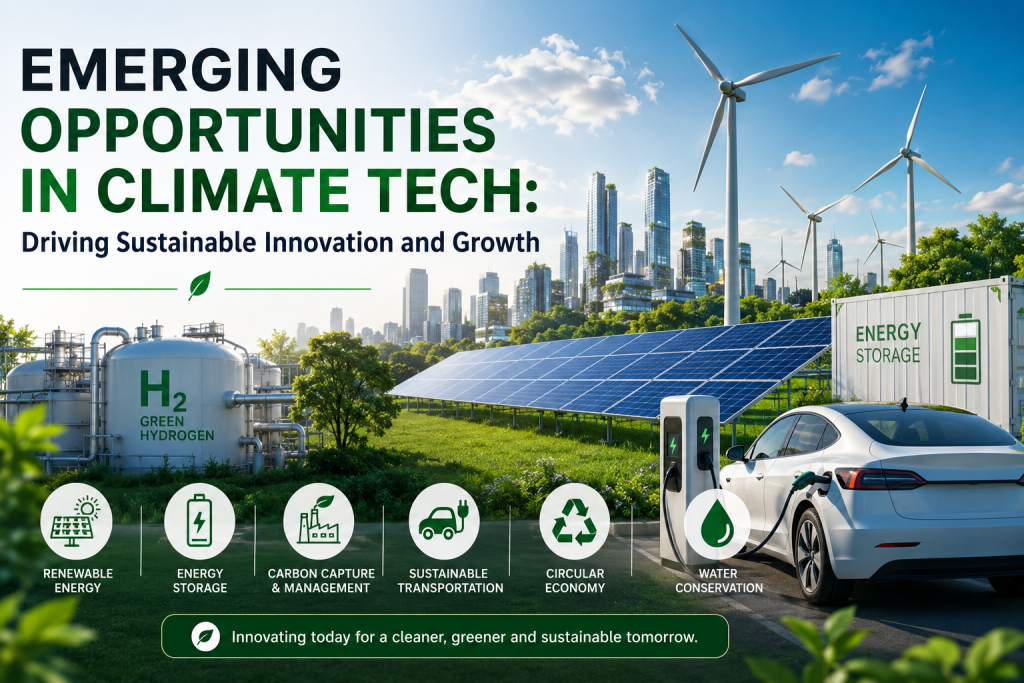

Climate technology, commonly known as Climate Tech, has emerged as one of the fastest-growing sectors driving global sustainability and economic transformation. As governments, businesses, and investors intensify efforts to reduce greenhouse gas emissions and achieve net-zero targets, climate-focused innovations are reshaping industries worldwide. From renewable energy and carbon capture to sustainable transportation and circular economy solutions, Climate Tech is creating new opportunities that extend far beyond environmental protection.
The growing urgency to combat climate change, combined with rapid technological advancements and supportive government policies, has accelerated investments in sustainable technologies. Organizations across energy, manufacturing, agriculture, construction, transportation, and finance are embracing climate-focused innovations to improve efficiency, reduce emissions, and build long-term resilience.
As the world transitions toward a low-carbon economy, Climate Tech is becoming a key driver of sustainable growth, creating new markets, attracting significant investments, and generating employment opportunities across multiple industries.
What Is Climate Tech?
Climate Tech refers to technologies, products, and services designed to reduce environmental impact, lower carbon emissions, improve resource efficiency, and support sustainable development. It combines digital innovation, clean energy solutions, advanced materials, smart infrastructure, and environmental management systems to address global climate challenges.
Unlike traditional environmental initiatives, Climate Tech focuses on scalable innovations that deliver measurable environmental and economic benefits. These technologies help businesses reduce operational costs while meeting increasingly stringent sustainability regulations and consumer expectations.
Today, Climate Tech spans renewable energy, battery storage, carbon management, electric mobility, water conservation, waste reduction, green buildings, precision agriculture, and climate monitoring systems.
Why Climate Tech Is Growing Rapidly
Several powerful factors are accelerating the expansion of Climate Tech worldwide.
Governments are implementing ambitious climate policies and investing heavily in clean energy infrastructure, sustainable transportation, and environmental innovation. Financial incentives, tax benefits, and green funding programs are encouraging organizations to adopt sustainable technologies.
Private investors and venture capital firms are also increasing investments in climate-focused startups developing innovative solutions for energy efficiency, carbon reduction, recycling, and resource management.
Consumers are becoming increasingly environmentally conscious, encouraging companies to develop sustainable products and adopt responsible business practices. Organizations that prioritize sustainability often improve brand reputation while strengthening customer loyalty.
Rapid technological advancements in renewable energy systems, energy storage, digital monitoring, and smart infrastructure continue to reduce costs while improving performance, making Climate Tech more commercially viable than ever before.
Emerging Opportunities in Climate Tech
Climate Tech is creating significant opportunities across multiple industries and business sectors.
Renewable Energy Expansion
Growing demand for clean electricity is accelerating investments in solar, wind, hydroelectric, and geothermal energy projects. Businesses involved in renewable energy equipment, installation, maintenance, and grid modernization are experiencing strong growth opportunities as countries diversify their energy sources.
Battery Energy Storage Systems
The increasing adoption of renewable energy has created rising demand for advanced battery storage solutions capable of ensuring reliable electricity supply. Battery Energy Storage Systems (BESS) improve grid stability, enable renewable integration, and support energy independence for businesses and communities.
Green Hydrogen Development
Green hydrogen is gaining momentum as a clean alternative fuel for industries that are difficult to electrify, including steel manufacturing, heavy transportation, aviation, and shipping. Investments in hydrogen production, storage, and distribution infrastructure continue to expand globally.
Carbon Capture and Carbon Management
Organizations are investing in technologies that capture, store, and monitor carbon emissions to support corporate sustainability goals and regulatory compliance. Carbon accounting software, emissions monitoring platforms, and carbon removal solutions represent growing business opportunities.
Sustainable Transportation
Electric vehicles, charging infrastructure, sustainable aviation fuels, rail electrification, and zero-emission logistics are transforming global transportation systems. Climate Tech companies developing clean mobility solutions continue attracting significant investment.
Smart Buildings and Green Construction
Energy-efficient buildings are becoming increasingly important for reducing operational costs and environmental impact. Smart building technologies, intelligent energy management systems, sustainable construction materials, and green infrastructure create new opportunities for developers and technology providers.
Circular Economy Solutions
Climate Tech supports waste reduction through recycling technologies, resource recovery systems, sustainable packaging, and product lifecycle management. Circular economy initiatives help businesses minimize waste while improving resource efficiency and reducing environmental impact.
Water Conservation Technologies
Climate change has intensified global water challenges, creating demand for advanced water treatment, recycling, desalination, leak detection, and smart water management systems. These technologies help industries and municipalities improve water security while reducing operational costs.
Key Technologies Driving Climate Tech
Several advanced technologies are accelerating Climate Tech innovation.
Artificial intelligence enables energy optimization, predictive maintenance, climate forecasting, and environmental monitoring. Cloud computing supports real-time data analysis, while Internet of Things (IoT) sensors collect valuable information from energy systems, buildings, and industrial facilities.
Satellite imagery and remote sensing technologies improve environmental monitoring by tracking land use, forest health, water resources, and carbon emissions. Digital twin technology allows organizations to simulate infrastructure performance and optimize sustainability initiatives before implementation.
Advanced materials, including high-performance batteries, lightweight composites, and recyclable construction materials, further enhance the efficiency and scalability of climate solutions.
Challenges Facing Climate Tech
Despite strong momentum, Climate Tech continues to face several challenges.
High initial investment costs remain a barrier for many organizations, particularly in developing economies. Large-scale infrastructure projects often require significant capital and long implementation periods before delivering financial returns.
Regulatory uncertainty across different regions can slow investment decisions and technology deployment. Standardized sustainability regulations and consistent policy frameworks remain essential for accelerating market growth.
Infrastructure limitations also affect adoption, particularly for electric vehicle charging networks, hydrogen transportation, renewable energy integration, and smart grid modernization.
In addition, organizations require skilled professionals capable of designing, deploying, and maintaining increasingly sophisticated climate technologies.
Future Outlook
The future of Climate Tech appears exceptionally promising as sustainability becomes a strategic priority across every major industry. Continued advancements in renewable energy, battery storage, carbon management, smart infrastructure, and resource optimization will create new opportunities for businesses, investors, and technology providers.
Digital technologies will play an increasingly important role in improving environmental performance through intelligent monitoring, automation, and predictive analytics. Organizations will continue integrating sustainability into their long-term business strategies while expanding investments in climate-focused innovation.
Collaboration between governments, private enterprises, research institutions, and financial organizations will further accelerate the commercialization of emerging climate technologies. As clean technologies become more affordable and scalable, Climate Tech will support both economic development and environmental resilience on a global scale.
Conclusion
Climate Tech is no longer a niche sector—it has become a powerful engine of sustainable innovation and economic growth. Growing environmental awareness, supportive government policies, technological advancements, and rising corporate sustainability commitments are creating unprecedented opportunities across renewable energy, transportation, manufacturing, construction, water management, and resource efficiency.
Businesses that invest in Climate Tech today are positioning themselves for long-term competitiveness while contributing to a cleaner and more resilient future. As innovation continues to accelerate, Climate Tech will remain at the center of the global transition toward sustainable development, unlocking new opportunities for industries, communities, and future generations.