
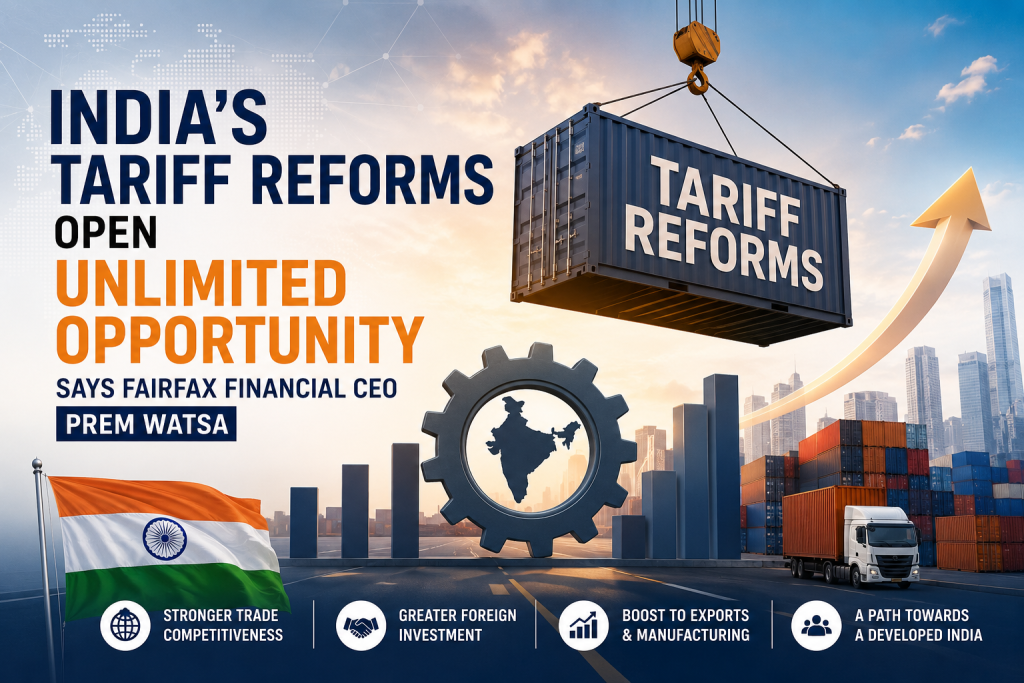

India’s trade landscape is entering a transformative phase, with sweeping tariff reforms expected to reshape the country’s position in global manufacturing and exports. As governments worldwide rethink supply chains and businesses diversify production beyond traditional hubs, India is positioning itself as an increasingly attractive destination for long-term investment.
That optimism was strongly echoed by Prem Watsa, Chairman and CEO of Fairfax Financial Holdings, who described India’s ongoing tariff reforms as creating “unlimited opportunity” for global businesses and investors. Speaking after receiving the 2026 US-India Strategic Partnership Forum (USISPF) Leadership Award, Watsa urged North American companies to view India as a strategic manufacturing and investment hub for the coming decades.
Why Tariff Reforms Matter
Tariffs influence the cost of importing and exporting goods, directly affecting business competitiveness and international trade.
India’s latest reforms aim to simplify the country’s tariff structure while reducing trade barriers with several partner nations. According to Watsa, discussions with Indian officials indicate that tariff reductions could significantly improve market access for businesses operating across multiple regions.
If implemented as planned, these measures could encourage greater foreign direct investment (FDI), strengthen export competitiveness, and accelerate India’s integration into global supply chains.
How Lower Tariffs Could Benefit Businesses
| Area | Potential Business Impact |
|---|---|
| Manufacturing | Lower input costs and improved global competitiveness |
| Foreign Investment | Increased attractiveness for multinational corporations |
| Exports | Better access to international markets through trade agreements |
| Supply Chains | Diversification away from traditional manufacturing hubs |
| Employment | Expansion of manufacturing and export-oriented industries |
India’s Manufacturing Ambition
India has steadily expanded initiatives designed to strengthen domestic manufacturing, including the “Make in India” campaign and production-linked incentive (PLI) schemes.
Watsa believes the next stage of growth will come from combining these initiatives with broader tariff liberalization.
His message to international businesses was clear: manufacture in India, leverage its expanding industrial ecosystem, and serve customers around the world. This reflects India’s broader ambition of becoming a developed economy by 2047, supported by stronger industrial capacity and deeper global trade integration.
India’s Opportunity in Numbers
One of the strongest arguments for investing in India remains its expanding consumer base.
During his remarks, Watsa highlighted that India’s middle class is expected to grow dramatically over the coming years, creating significant domestic demand alongside export opportunities.
Growing Middle Class
          │
          ▼
Higher Consumer Demand
          │
          ▼
Greater Manufacturing Investment
          │
          ▼
Export Expansion
          │
          ▼
Long-Term Economic Growth
This combination of domestic consumption and export potential makes India unique among major emerging economies.
Venture Capital and Entrepreneurship Continue to Grow
Beyond manufacturing, Watsa praised India’s rapidly evolving startup ecosystem.
He noted that today’s entrepreneurs have significantly better access to venture capital than previous generations, allowing innovative ideas to secure funding regardless of personal background.
The expansion of venture funding, digital infrastructure, and technology adoption has contributed to India’s emergence as one of the world’s largest startup ecosystems, particularly in fintech, SaaS, artificial intelligence, healthcare, and logistics.
Challenges That Still Require Attention
While the outlook is positive, several factors will influence the pace of India’s transformation:
- Successful implementation of tariff reforms
- Completion of bilateral and multilateral trade agreements
- Continued infrastructure development
- Regulatory consistency
- Global economic conditions
- Supply chain resilience
Businesses are likely to monitor these developments closely before making large-scale investment decisions.
What This Means for Global Investors
For multinational corporations, India’s evolving trade policies may present an opportunity to diversify manufacturing operations while gaining access to one of the world’s fastest-growing consumer markets.
Lower tariffs can reduce production costs, improve export competitiveness, and strengthen India’s position within global value chains. Combined with ongoing investments in infrastructure, digitalization, and industrial development, these reforms could encourage greater participation from international manufacturers and institutional investors.
At the same time, businesses will continue evaluating how quickly reforms translate into practical improvements in trade efficiency and market access.
Looking Ahead
India’s tariff reforms represent more than a policy adjustment—they signal a broader effort to make the country a preferred destination for global manufacturing, investment, and exports.
Prem Watsa’s optimistic assessment reflects growing international confidence in India’s long-term economic trajectory. While the full impact of the reforms will depend on implementation and evolving trade agreements, the direction is clear: India is seeking a larger role in global commerce by combining domestic growth with greater openness to international business.
Related Reading
Businesses evaluating India’s investment landscape should also follow developments in free trade agreements, export promotion policies, manufacturing incentives, and global supply chain diversification, as these areas are likely to shape the country’s competitiveness over the next decade.
Key Takeaways
- India is pursuing tariff reforms to improve trade competitiveness.
- Fairfax CEO Prem Watsa believes the reforms create “unlimited opportunity” for global investors.
- Manufacturing, exports, and foreign investment could benefit from lower trade barriers.
- India’s expanding middle class strengthens the long-term investment case.
- Implementation of trade agreements and policy reforms will determine the pace of future growth.