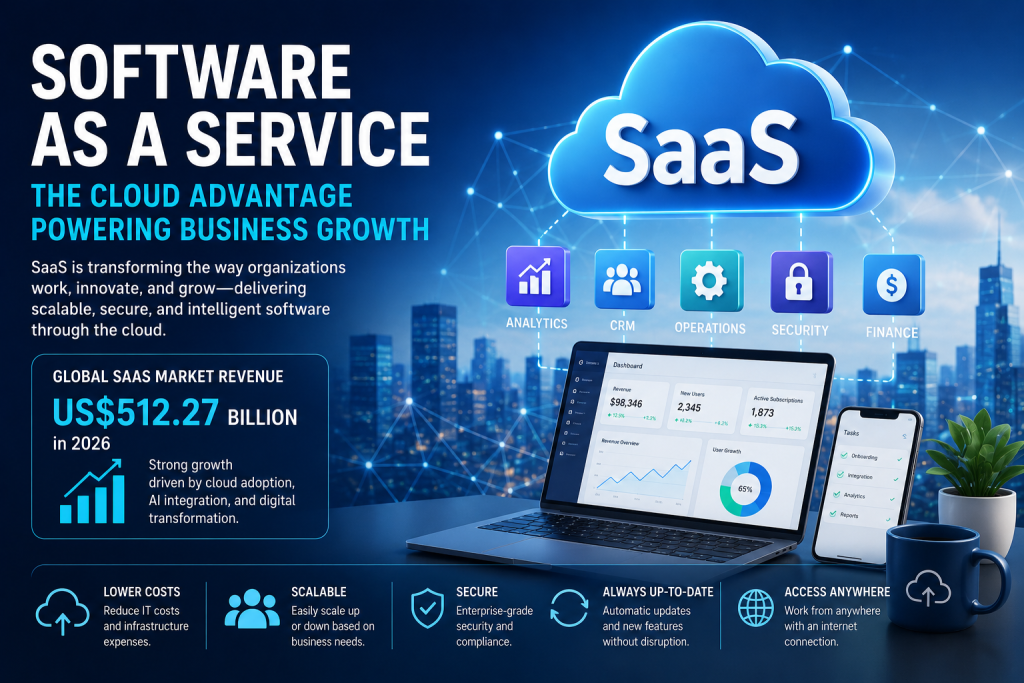

Software as a Service (SaaS) has fundamentally changed how organizations purchase, deploy, and manage software. Instead of investing in expensive on-premise infrastructure and perpetual software licenses, businesses today can access enterprise-grade applications through cloud-based subscriptions. This shift has made software more affordable, scalable, and accessible for organizations of every size.
From startups and small businesses to multinational enterprises, SaaS applications now power everything from customer relationship management (CRM) and human resources to finance, collaboration, cybersecurity, and artificial intelligence. As digital transformation accelerates across industries, SaaS continues to emerge as one of the fastest-growing segments within the global cloud computing ecosystem.
🔑 Key Takeaways
| Topic | Details |
|---|---|
| Industry | Cloud Computing |
| Segment | Software as a Service (SaaS) |
| Projected Global Revenue (2026) | US$512.27 Billion |
| Growth Driver | Cloud adoption, AI integration, remote work |
| Key Trend | Subscription-based enterprise software |
Understanding Software as a Service
Software as a Service is a cloud delivery model where applications are hosted by a provider and accessed through the internet. Rather than installing software on local computers or maintaining dedicated servers, users simply log in through a web browser or mobile application.
The SaaS provider handles infrastructure, security, maintenance, software updates, backups, and scalability, allowing businesses to focus on operations instead of IT management.
This model has become increasingly attractive because it lowers upfront costs while providing businesses with continuous access to the latest software features.
The Rapid Growth of the SaaS Market
Cloud computing has become the foundation of modern digital business, and SaaS represents its largest application layer.
According to Statista’s market outlook, worldwide SaaS revenue is expected to reach US$512.27 billion in 2026, with continued annual growth as organizations accelerate cloud adoption and digital transformation initiatives.
Several factors are contributing to this expansion:
- Growing adoption of hybrid and remote work
- Increasing reliance on cloud infrastructure
- Rising demand for AI-powered business applications
- Subscription-based pricing models
- Continuous software innovation
- Faster enterprise digital transformation
These trends continue to reshape how businesses invest in technology.
Why Businesses Prefer SaaS Solutions
One of SaaS’s greatest strengths is its flexibility.
Organizations no longer need significant capital investments to access enterprise software. Instead, they can scale subscriptions based on business requirements while reducing maintenance costs.
Major business benefits include:
| Business Benefit | Impact |
| Lower IT Costs | Eliminates expensive hardware and maintenance |
| Scalability | Easily add or remove users |
| Automatic Updates | Always access the latest features |
| Global Accessibility | Work securely from anywhere |
| Faster Deployment | Applications can be implemented quickly |
| Improved Collaboration | Teams work together in real time |
These advantages explain why SaaS adoption continues expanding across every major industry.
Artificial Intelligence Is Reshaping SaaS
Artificial intelligence has become one of the biggest innovation drivers within the SaaS industry.
Modern platforms increasingly include AI-powered capabilities such as:
- Intelligent automation
- Predictive analytics
- Virtual assistants
- Natural language search
- Workflow optimization
- Personalized customer experiences
Rather than functioning as standalone tools, AI features are becoming embedded directly into enterprise software, helping organizations improve productivity while reducing manual workloads.
This trend is expected to accelerate over the next several years as generative AI capabilities continue evolving.
Industries Leading SaaS Adoption
Virtually every industry now relies on SaaS applications to improve efficiency and customer engagement.
Some of the largest adopters include:
- Financial Services
- Healthcare
- Manufacturing
- Retail & E-commerce
- Education
- Telecommunications
- Government
- Professional Services
- Logistics
- Media & Entertainment
From electronic medical records to supply chain optimization and customer relationship management, SaaS has become an essential component of digital business operations.
Challenges Facing the SaaS Industry
Despite its rapid growth, SaaS providers continue facing several important challenges.
Cybersecurity remains a primary concern as organizations store increasing volumes of sensitive data in cloud environments.
Businesses must also consider:
- Data privacy compliance
- Vendor lock-in
- Subscription cost management
- Service reliability
- Integration with legacy systems
- Identity and access management
Leading SaaS providers continue investing heavily in encryption, compliance certifications, zero-trust security models, and AI-driven threat detection to strengthen customer confidence.
The Future of Software as a Service
The SaaS industry continues evolving far beyond traditional software delivery.
Future platforms are expected to feature:
- Deeper AI integration
- Industry-specific SaaS solutions
- Low-code and no-code development
- Advanced workflow automation
- Greater personalization
- Stronger cybersecurity
- Multi-cloud interoperability
As organizations increasingly prioritize agility and operational efficiency, SaaS will remain one of the most important technology investment areas for businesses worldwide.
Frequently Asked Questions
What is Software as a Service (SaaS)?
Software as a Service is a cloud-based software delivery model in which users access applications over the internet through subscriptions rather than purchasing and installing software locally.
Why is SaaS growing so quickly?
Organizations are increasingly adopting SaaS because it reduces infrastructure costs, improves scalability, supports remote work, and provides continuous software updates. Continued investment in cloud computing and AI is further accelerating market growth.
Which industries use SaaS the most?
Healthcare, banking, retail, education, manufacturing, logistics, government, telecommunications, and professional services are among the largest adopters.
What technologies are shaping the future of SaaS?
Artificial intelligence, machine learning, cloud computing, automation, cybersecurity, and low-code development platforms are expected to drive the next generation of SaaS innovation.
Final Thoughts
Software as a Service has transformed from a convenient software delivery model into the foundation of modern enterprise technology. By combining scalability, affordability, continuous innovation, and cloud accessibility, SaaS enables organizations to respond more quickly to changing business needs while reducing operational complexity.
As artificial intelligence, automation, and cloud computing continue advancing, SaaS platforms will become even more intelligent, personalized, and indispensable. Businesses that embrace these technologies today will be better positioned to improve efficiency, enhance customer experiences, and maintain a competitive advantage in an increasingly digital economy.