
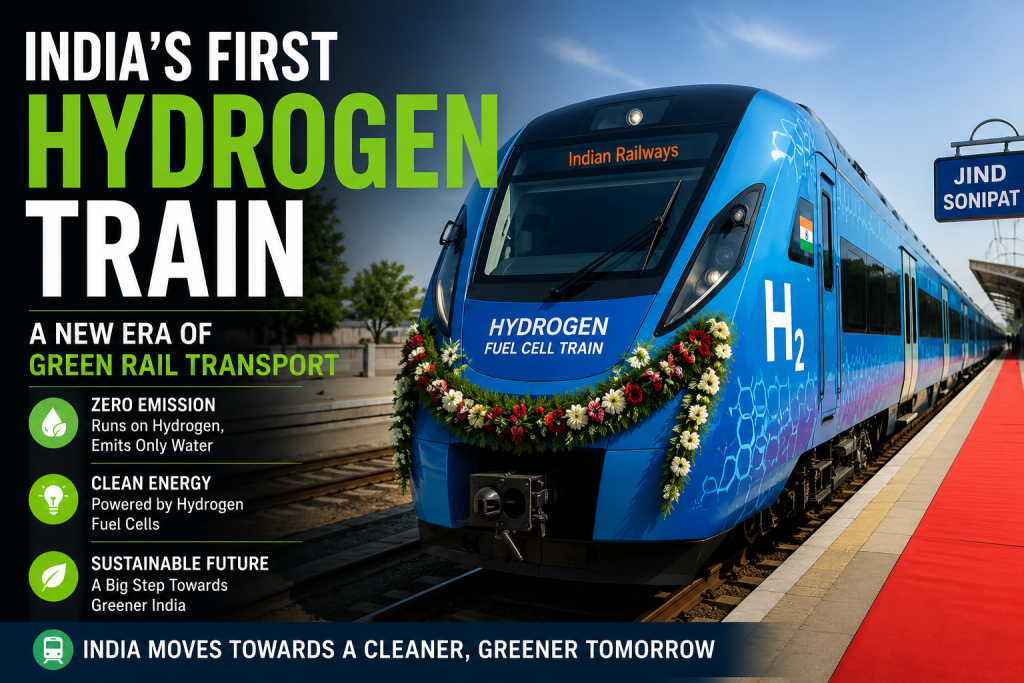

India has officially entered the era of hydrogen-powered rail transport with the launch of its first indigenous hydrogen fuel cell train, a landmark step in the country’s clean mobility mission. Flagged off by Prime Minister Narendra Modi, the train will operate on the Jind–Sonipat route in Haryana, showcasing Indian Railways’ commitment to sustainable transportation and reduced carbon emissions. The hydrogen-powered train is expected to play a crucial role in decarbonizing rail travel, particularly on non-electrified routes where diesel locomotives remain in operation.
India Joins an Elite Group of Nations
With this launch, India joins a select list of countries—including Germany, Japan, China, and the United States—that have introduced hydrogen-powered passenger trains. The project is part of the government’s broader Green Hydrogen Mission and reflects India’s ambition to achieve net-zero carbon emissions by 2070 while modernizing one of the world’s largest railway networks.
What Makes India’s Hydrogen Train Special?
Unlike conventional diesel locomotives, the hydrogen train generates electricity onboard using hydrogen fuel cells. Hydrogen combines with oxygen inside the fuel cell to produce electricity, which powers the train’s electric motors. The only by-products of this process are water vapour and heat, making it a virtually zero-emission transportation solution at the point of use.
The indigenously developed train features:
- A 10-coach configuration.
- Capacity to carry approximately 2,600 passengers.
- Maximum design speed of 110 km/h, with an operational speed of 75 km/h on the Jind–Sonipat route.
- Advanced hydrogen storage systems and multiple safety mechanisms for leak detection and fire prevention.
A Major Boost for Sustainable Rail Mobility
Indian Railways has already electrified most of its high-density network, but several regional and remote routes continue to rely on diesel-powered trains. Hydrogen-powered trains provide a cleaner alternative without requiring expensive overhead electrification infrastructure, making them particularly suitable for such corridors.
Officials believe the project will serve as a pilot for future hydrogen-based transportation initiatives across India while supporting domestic innovation in clean energy technologies.
Challenges Remain Before Wider Adoption
Despite their environmental advantages, hydrogen-powered trains face several hurdles before large-scale deployment. Producing green hydrogen remains expensive, while storage, transportation, and refuelling infrastructure require significant investment. Additionally, hydrogen fuel cell technology is still evolving, meaning operational costs remain higher than conventional electrified rail systems.
Experts suggest hydrogen trains are likely to complement, rather than replace, India’s expanding electric railway network, particularly on routes where electrification is impractical.
A Milestone for India’s Green Hydrogen Mission
The successful rollout of the country’s first hydrogen-powered train represents more than just a technological achievement—it signals India’s growing commitment to sustainable infrastructure and clean transportation. As hydrogen production scales up and supporting infrastructure develops, similar trains could become an increasingly viable option for regional rail services and other sectors seeking low-carbon mobility solutions.