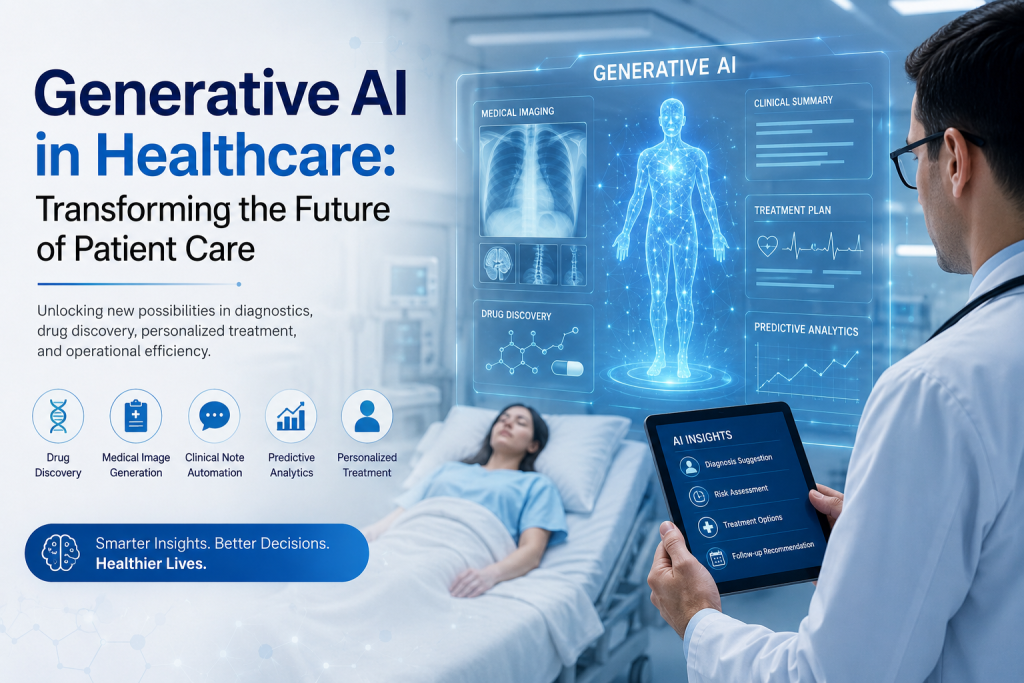

Healthcare is undergoing a remarkable transformation with the rapid adoption of Generative Artificial Intelligence (Generative AI). From accelerating drug discovery and improving clinical documentation to enhancing medical imaging and personalizing patient care, generative AI is redefining how healthcare providers, researchers, and pharmaceutical companies operate. As large language models (LLMs), multimodal AI, and foundation models continue to advance, healthcare organizations are leveraging these technologies to improve efficiency, reduce costs, and deliver better patient outcomes.
Unlike traditional AI systems that primarily analyze data, generative AI can create new content, summarize complex medical records, generate clinical notes, assist in diagnostics, and even support medical research. As healthcare systems face increasing pressure from workforce shortages, rising costs, and growing patient demands, generative AI is emerging as one of the most impactful technologies driving digital healthcare innovation.
What Is Generative AI in Healthcare?
Generative AI in healthcare refers to the use of advanced artificial intelligence models capable of generating text, images, code, audio, and synthetic data to support various medical and administrative tasks. These AI models are trained on massive datasets and can understand complex medical language, recognize patterns, and generate highly contextual responses.
Key technologies powering generative AI in healthcare include:
- Large Language Models (LLMs)
- Machine Learning (ML)
- Deep Learning
- Natural Language Processing (NLP)
- Computer Vision
- Foundation Models
- Multimodal AI
- Generative Adversarial Networks (GANs)
- Synthetic Data Generation
- Cloud AI Platforms
Together, these technologies enable healthcare organizations to automate repetitive tasks, improve clinical decision-making, and accelerate innovation.
Clinical Documentation and Administrative Efficiency
Administrative work consumes a significant portion of healthcare professionals’ time. Generative AI is helping reduce this burden by automating documentation and streamlining workflows.
Major applications include:
- Automated clinical note generation
- Medical transcription
- Patient visit summaries
- Electronic Health Record (EHR) documentation
- AI-powered coding assistance
- Insurance claim documentation
These solutions allow physicians to spend more time with patients while reducing administrative workload and documentation errors.
Medical Imaging and Diagnostics
Generative AI is enhancing diagnostic accuracy by assisting radiologists and clinicians in analyzing medical images more efficiently.
Key innovations include:
- AI-assisted MRI analysis
- CT scan interpretation
- X-ray image enhancement
- Pathology image analysis
- Early disease detection
- Automated diagnostic report generation
These technologies improve diagnostic confidence, accelerate reporting, and support earlier intervention for critical diseases.
Drug Discovery and Pharmaceutical Research
Developing new drugs traditionally requires years of research and billions of dollars in investment. Generative AI is significantly shortening this process.
Emerging opportunities include:
- Drug molecule generation
- Protein structure prediction
- Clinical trial optimization
- Drug repurposing
- Biomarker discovery
- Toxicity prediction
By accelerating pharmaceutical research, generative AI has the potential to bring life-saving therapies to market faster.
Personalized Patient Care
Generative AI is enabling healthcare providers to deliver more personalized and patient-centered care through intelligent insights and recommendations.
Applications include:
- Personalized treatment planning
- AI health assistants
- Patient education content generation
- Medication adherence support
- Chronic disease management
- Lifestyle and wellness recommendations
These capabilities improve patient engagement and support better long-term health outcomes.
Medical Research and Knowledge Management
Researchers are increasingly using generative AI to process vast volumes of scientific literature and accelerate medical discoveries.
Key applications include:
- Scientific literature summarization
- Research paper generation assistance
- Clinical evidence synthesis
- Medical knowledge extraction
- Automated data analysis
- Hypothesis generation
These tools enable researchers to focus more on innovation while reducing time spent on manual information gathering.
Telemedicine and Virtual Healthcare
Virtual healthcare continues to expand, and generative AI is making remote care more efficient and accessible.
Digital healthcare innovations include:
- AI-powered virtual health assistants
- Intelligent symptom assessment
- Appointment scheduling
- Remote patient communication
- Follow-up care automation
- Multilingual healthcare support
These technologies improve patient accessibility while helping healthcare providers manage larger patient populations.
Medical Education and Clinical Training
Generative AI is transforming healthcare education by creating interactive learning experiences for students and professionals.
Applications include:
- AI-generated clinical case studies
- Virtual patient simulations
- Personalized learning content
- Medical exam preparation
- Surgical training assistance
- Continuing medical education support
These innovations improve learning outcomes and help healthcare professionals stay current with rapidly evolving medical knowledge.
Healthcare Operations and Hospital Management
Hospitals are adopting generative AI to improve operational efficiency and optimize resource utilization.
Key operational applications include:
- Workforce scheduling
- Hospital capacity planning
- Predictive patient admissions
- Supply chain optimization
- Medical inventory management
- Operational analytics
These solutions reduce operational costs while improving healthcare delivery.
Synthetic Data for Healthcare Innovation
One of the most promising applications of generative AI is the creation of synthetic healthcare data that preserves patient privacy while supporting research and AI model development.
Important use cases include:
- Privacy-preserving medical datasets
- AI model training
- Clinical research
- Rare disease simulation
- Medical image generation
- Data augmentation
Synthetic data enables innovation while helping organizations comply with privacy regulations.
Challenges Facing Generative AI in Healthcare
Although generative AI offers enormous potential, healthcare organizations must address several important challenges before achieving widespread adoption.
Common challenges include:
- Patient data privacy
- AI hallucinations and misinformation
- Regulatory compliance
- Model transparency
- Ethical concerns
- Bias in AI algorithms
- Cybersecurity risks
- Integration with legacy healthcare systems
Responsible AI governance, human oversight, and strong regulatory frameworks will be essential to ensuring safe and effective deployment.
Future Outlook
Generative AI is expected to become an integral component of modern healthcare over the coming years. As AI models become more accurate, secure, and explainable, they will increasingly support clinicians, researchers, pharmaceutical companies, insurers, and healthcare administrators.
Future developments are likely to include highly personalized medicine, AI-assisted robotic surgery, faster drug development, predictive disease prevention, intelligent hospital operations, and real-time clinical decision support. Collaboration between technology providers, healthcare institutions, regulators, and researchers will be essential to unlocking the full potential of generative AI while maintaining patient safety and ethical standards.
Healthcare organizations that strategically adopt generative AI today will be better positioned to improve care quality, increase operational efficiency, reduce costs, and drive innovation in an increasingly digital healthcare ecosystem.
Conclusion
Generative AI is reshaping healthcare by improving clinical workflows, accelerating medical research, enhancing diagnostics, supporting personalized treatment, and streamlining hospital operations. From drug discovery and medical imaging to virtual healthcare and clinical documentation, the technology offers significant opportunities across the healthcare value chain. While challenges related to privacy, regulation, and AI governance remain, continued advancements in generative AI are expected to revolutionize patient care and healthcare delivery. Organizations that embrace responsible AI innovation will be well-equipped to lead the next generation of intelligent healthcare.